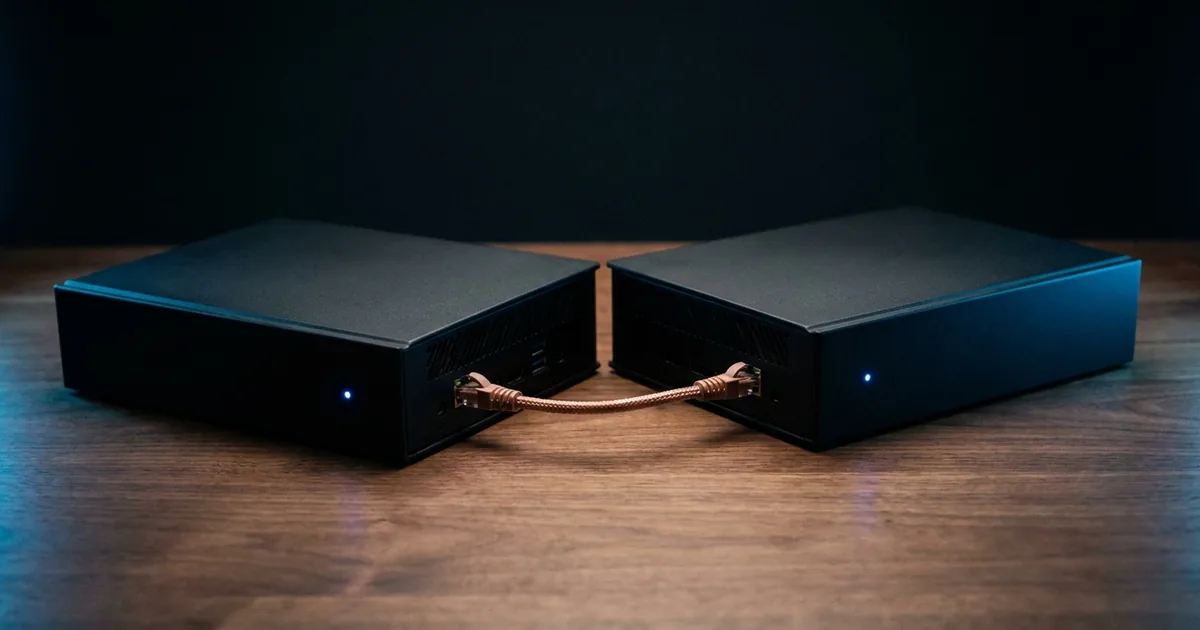
If you have searched for a DGX Spark cable you have run into a wall of part numbers: NJAAKK-N911 on the retail listings, NJAAKK0006 and LMTQF022-SD-R in NVIDIA's documentation, and NJAAKR-0006 on the cable we ship. They look like four different products. They are not. They are one specification, two manufacturers, two lengths and two wire gauges, and once you can read the digits the buying decision takes about a minute. This post decodes each part number, explains what the port on the back of the box actually negotiates, and tells you how many cables you need for two, three or more GB10 units.
Every measurement here comes from our own two-unit and eight-unit GB10 testing, published in the two-Spark cable guide and the public cluster guide it links to, or from NVIDIA's DGX Spark user guide. Nothing is quoted from a reseller.
NJAAKK-N911, NJAAKK0006 and LMTQF022-SD-R: the three cables NVIDIA lists for the DGX Spark QSFP ports
NVIDIA's DGX Spark user guide lists three approved cables for the two QSFP ports on the back of the unit. In the guide's own words and units:
- Amphenol NJAAKK-N911: QSFP to QSFP112, 32 AWG, 400 mm, LSZH.
- Amphenol NJAAKK0006: the 0.5 m version of the same part.
- Luxshare LMTQF022-SD-R: QSFP112 400G DAC cable, 400 mm, 30 AWG.
All three share the properties that matter. They are passive direct-attach copper, which means a copper cable with a QSFP112 connector crimped on each end and no electronics inside the plug. They are rated for 400G, which is the ceiling of the QSFP112 form factor. And they are short, between 400 mm and 0.5 m, because the use case is two small boxes sitting side by side or stacked. NVIDIA's Spark Stacking documentation names the Amphenol NJAAKK0006 and the Luxshare LMTQF022-SD-R as the reference spec, and that pairing is the key to the whole table: one spec, built by two cable manufacturers.
NJAAKK-N911: what the retail listings are selling
NJAAKK-N911 is the part number you will see most often, because it is the one NVIDIA's own retail channel uses. Retailers list it as the NVIDIA DGX Spark Stacking DAC Cable (QSFP/CX7), and the specification printed on the listing matches the user guide: QSFP to QSFP112, 32 AWG, 400 mm, LSZH jacket. The 400 mm figure is the same 40 cm you will see written on a product page, and LSZH is a low-smoke zero-halogen jacket compound, a fire-safety rating for the plastic, not an electrical property.
Two things are worth knowing about this listing before you buy it. First, the N911 suffix is a length and build variant inside Amphenol's NJAAKK family, which is why the 0.5 m sibling carries a different suffix. Second, stock on the retail listing comes and goes, and when it goes, buyers start searching for the other part numbers in the user guide. That is usually how people land on this page.
NJAAKK0006: the 0.5 m sibling
NJAAKK0006 is the number NVIDIA's documentation uses for the manufactured specification, and the user guide describes it as the 0.5 m version of the N911. Same Amphenol family, same QSFP112 connectors, same passive 400G copper, ten centimetres longer. If you are stacking two units one on top of the other, the 400 mm cable reaches with a tight bend; the 0.5 m cable reaches with slack. On a desk with the two units side by side, either length is fine.
Because NJAAKK0006 is the specification name rather than a widely stocked retail SKU, you will rarely find it in a shopping cart under that exact string. What you will find are cables from the same family built to it, which brings us to the part we stock.
Luxshare LMTQF022-SD-R: the second source
The Luxshare LMTQF022-SD-R is the third cable in the user guide and the one that tells you the most about what the port actually requires. It is listed as a QSFP112 400G DAC, 400 mm, 30 AWG. Compare that with the N911: same connector, same length, same 400G rating, but a different manufacturer and a thicker 30 AWG conductor instead of 32 AWG. NVIDIA approved both. That is the clearest possible statement that the port does not care whether the copper inside the jacket is 30 or 32 gauge at these lengths, and it is why a 30 AWG cable built to the same spec is a like-for-like substitute for a 32 AWG one.
NJAAKR-0006: the cable we ship, and how it relates to the three above
The cable Petronella Technology Group, Inc. stocks is the Amphenol NJAAKR-0006: a 0.5 m QSFP112 passive DAC at 30 AWG, from the same Amphenol family as the NJAAKK parts, built to the NJAAKK0006 / LMTQF022-SD-R specification that the Spark Stacking documentation names. Our current shelf stock is jacket-stamped Amphenol NJAAKR-0006, Rev G, and we photograph the bag label and the tab on the cable product page so you can read it yourself.
To be precise about the claim, because precision is the whole point of a part-number article: NJAAKR-0006 is not the same part number as NJAAKK-N911, NJAAKK0006 or LMTQF022-SD-R, and we do not say it is. It is the 0.5 m length built to the same specification, with the 30 AWG conductor that NVIDIA already approved in the Luxshare part. Electrically it is interchangeable: passive copper, no firmware, no vendor lock, and the ConnectX-7 drives it directly. Owners on the NVIDIA developer forum report full-rate links with it, and so do we, with the numbers below.
Where it differs from the retail N911 listing is availability and price. We keep it in stock in the United States, it ships in 1 to 3 business days, and it is $159 with free US shipping for a single cable. A 2-pack is $299 and the 3-pack ring kit for a three-unit switchless cluster is $435.
Order today: Buy the DGX Spark cable for $159, free US shipping. In stock, ships in 1 to 3 business days, one cable connects any two GB10 units.
Reading the digits: 30 AWG vs 32 AWG, 400 mm vs 0.5 m, 400G vs 200G
Three numbers on these listings cause most of the confusion, so here is what each one means and whether it should change your decision.
AWG is wire gauge, and lower is thicker
AWG is the American Wire Gauge scale, and the number runs backwards: 30 AWG copper is thicker than 32 AWG copper. Thicker copper has lower resistance, which is why longer passive cables use heavier gauges and why you see 26 AWG on 2 m and 3 m passive DACs. At 400 mm to 0.5 m the difference is irrelevant to the link; NVIDIA's user guide lists a 32 AWG cable and a 30 AWG cable as approved for the same port. Buy whichever is in stock.
400 mm and 0.5 m are the same cable in two lengths
The N911 and the Luxshare part are 400 mm. The NJAAKK0006 and the NJAAKR-0006 are 0.5 m. The difference is ten centimetres. Both reach between two units side by side or stacked, and neither is long enough to run between two shelves. If the two units are separated by a monitor, you want 1 m; across two shelves, 2 m; across a small rack, 3 m, and at 3 m you are into active copper. None of that applies to a pair on one desk, which is why the approved list stops at 0.5 m.
400G is the cable rating, 200G is the port
Every cable in this article is labelled 400G because that is what QSFP112 copper can carry. The ConnectX-7 port on the GB10 is documented by NVIDIA at up to 200 Gb/s, Ethernet configuration only, so the link negotiates at 200G regardless of the cable. The extra rating is headroom against the spec, not speed you can unlock. Our bandwidth explainer walks through the bits-versus-bytes arithmetic, including why 200 Gb/s is about 25 GB/s and how that compares with the 273 GB/s of local memory bandwidth inside each unit.
What the port negotiates, and the number to expect
Turn a DGX Spark around and the two identical square cages next to the RJ45 jack are QSFP112 ports on an NVIDIA ConnectX-7. The left port, closest to the RJ45, is Port 0; the right port is Port 1. The same two cages on the same ConnectX-7 are on every GB10 workstation regardless of the badge on the front.
One structural fact explains almost every confusing benchmark posted about these ports. The ConnectX-7 connects to the GB10 chip over two independent PCIe Gen 5 x4 links, so each physical port shows up in Linux twice: Port 0 appears as the Ethernet interfaces enp1s0f0np0 and enP2p1s0f0np0, and as the RDMA devices rocep1s0f0 and roceP2p1s0f0. They are the same wire. Each PCIe half carries roughly 100 Gb/s, and to see the full 200 Gb/s on one cable you need traffic on both halves at once. NCCL does that on its own when you hand it both RDMA devices. A single TCP stream does not, which is why a plain iperf run shows about half the line rate and sends people hunting for a faulty cable that is not faulty.
Our direct-cable measurements on two units, using the Amphenol NJAAKR-0006 and the commands published in the cluster guide's validation chapter:
- One PCIe half, ib_write_bw: 111.86 Gb/s.
- Both halves running concurrently: 98.04 + 98.04 = 196.08 Gb/s, about 98 percent of the 200 Gb/s line rate.
So one cable, correctly configured, delivers about 196 Gb/s. That is the ceiling for any of the four part numbers in this article, because the ceiling is the port, not the cable. It is also why a second cable between the same two units does not add bandwidth, and why adding a second Spark is a capacity decision (more memory, more models loaded) rather than a speed decision.
Which GB10 systems take the same cable
Every GB10 Grace Blackwell workstation uses the same ConnectX-7 with the same two QSFP112 ports, so the cable NVIDIA names for the DGX Spark is the same electrical part for the OEM builds. That includes the ASUS Ascent GX10, the Dell Pro Max GB10, the HP ZGX Nano G1n, the Lenovo ThinkStation PGX, the MSI EdgeXpert MS-C931, the Acer Veriton GN100 and the Gigabyte AI TOP ATOM. You can also mix brands across one cable, because the link is standard 200G Ethernet over QSFP112 and nothing in it is vendor-specific. We have cabled DGX Spark Founders Edition units to OEM units and the link negotiates the same way.
The practical consequence is that you do not need an OEM-branded cable, and no OEM sells a different one. The part numbers in NVIDIA's user guide apply to the whole GB10 family.
How many cables for two, three, four or eight units
The cable count follows directly from the two ports on each box.
- Two units: one cable, Port 0 to Port 0. That is NVIDIA's own two-Spark playbook and the whole shopping list.
- Three units: a switchless ring with three cables. Each unit uses both ports, so every unit is one hop from every other. Our port-by-port wiring guide gives the exact port map.
- Four units or more: add a switch and one cable per unit. A four-node ring puts two nodes two hops apart, and from there the switch is cheaper than the lost bandwidth. The switch-versus-ring comparison covers 4 to 8 nodes, and we run an eight-unit GB10 fabric ourselves for the LLM benchmark lab.
When a switch enters the picture the cable from each unit to the switch is still the same short passive DAC as long as the switch sits beside the units. Past about 2 m you move to a heavier gauge passive cable or to active copper, and that is the point where the four part numbers in this article stop being the right answer, because all of them are 0.5 m or shorter.
A buying checklist for any DGX Spark cable listing
Whether the listing says NJAAKK-N911, NJAAKK0006, LMTQF022-SD-R, NJAAKR-0006 or a generic description, check the same five things.
- Passive, not active. No electronics in the plug. An active cable or an optical transceiver pair adds powered parts to a link that passive copper handles at full rate over half a metre, so you add cost and a failure point and gain no bandwidth.
- QSFP112 connectors. This is the form factor the port and NVIDIA's documentation call for. Buyers on the developer forum keep asking whether a 200G QSFP56 cable would do, and some report that it links. For a pair of workstations at this price, buy the cable NVIDIA documents; a QSFP112 400G DAC is guaranteed against the spec the Spark Stacking guide names and removes the one variable you would otherwise be debugging.
- 400G rating. The port only needs 200G, but the 400G rating is how you know the cable is built to the QSFP112 spec rather than an older QSFP28 or QSFP56 design with a similar-looking plug.
- 400 mm to 0.5 m. Long enough for side by side or stacked, short enough to stay on the approved list. Longer passive cables exist and work for shelf-to-shelf runs, but they are a different purchase.
- In stock and shipping now. The GB10 units themselves are shipping, and a cable listing with a multi-week delivery window is the most common reason a two-unit cluster sits idle. Check the ship date before the price.
If a listing passes all five, the part number on the bag is a detail. If it fails any one of them, the part number does not save it.
Bring-up: proving the link before you load a model
Once the cable is in, three checks confirm the link is running at line rate. First, both Ethernet interfaces for Port 0 should show a link at 200000 Mb/s in ethtool on each unit. Second, assign addresses on both halves and ping across each. Third, run ib_write_bw against each RDMA device, then both together, and expect about 111 Gb/s on one and about 196 Gb/s combined. The full command sequence, with the output we recorded, is in the validation chapter of the public cluster guide linked from the two-Sparks-to-switched-fabric post. If one half shows a link and the other does not, the cable is seated but one PCIe half is not configured; it is a software step, not a cable fault.
Related reading
- DGX Spark Cluster Cable (QSFP112 400G DAC)
- DGX Spark Cluster Cables In Stock: 0.5m QSFP112, $159
- What Cable Do I Need to Connect Two DGX Sparks?
- DGX Spark Cluster: 4 to 8 Nodes, Switch vs Ring
- DGX Spark Memory Bandwidth: 273 GB/s, and What 400G Adds
FAQ
Is NJAAKK-N911 the same cable as NJAAKK0006?
They are two lengths of the same Amphenol design. NVIDIA's DGX Spark user guide lists NJAAKK-N911 as a QSFP to QSFP112 cable, 32 AWG, 400 mm, LSZH, and NJAAKK0006 as the 0.5 m version of the same part. Both are passive QSFP112 400G direct-attach copper cables, and both are approved for the DGX Spark QSFP ports.
What is the Amphenol NJAAKR-0006 and is it approved for DGX Spark?
NJAAKR-0006 is a 0.5 m QSFP112 passive DAC at 30 AWG from the same Amphenol family, built to the NJAAKK0006 and Luxshare LMTQF022-SD-R specification that NVIDIA's Spark Stacking documentation names. It is not one of the three part numbers printed in the user guide, and we do not claim it is. It is the 0.5 m length built to the same spec, and it links at the full 200 Gb/s port rate; we measured 196 Gb/s across one cable.
Does 30 AWG versus 32 AWG matter for a DGX Spark stacking cable?
Not at these lengths. AWG is the wire gauge, and a lower number means a thicker conductor. NVIDIA lists both a 32 AWG cable (NJAAKK-N911) and a 30 AWG cable (Luxshare LMTQF022-SD-R) as approved for the same port, which tells you the port does not care which gauge you buy at 400 mm to 0.5 m. Both are passive copper with no electronics in the plug.
Why does a 400G cable only run at 200 Gb/s on DGX Spark?
The cable is rated for 400G because that is what QSFP112 copper can carry. The ConnectX-7 port on the GB10 is documented at up to 200 Gb/s, so that is where the link negotiates. The extra rating is headroom against the spec, not speed you get. On two units we measured 111.86 Gb/s on one PCIe half of the port and 196.08 Gb/s with both halves carrying traffic.
How many cables do I need for two, three or four DGX Sparks?
Two units need one cable, Port 0 to Port 0. Three units make a switchless ring with three cables, each unit using both of its QSFP112 ports. From four units up you add a switch and one cable per unit, because a four-node ring puts two nodes two hops apart.
Does the same part number fit the ASUS, Dell, HP, Lenovo, MSI, Acer and Gigabyte GB10 systems?
Yes. Every GB10 Grace Blackwell workstation carries the same NVIDIA ConnectX-7 network controller with two QSFP112 ports, so the cable that NVIDIA's documentation names for the DGX Spark is the same electrical part for the ASUS Ascent GX10, Dell Pro Max GB10, HP ZGX Nano G1n, Lenovo ThinkStation PGX, MSI EdgeXpert MS-C931, Acer Veriton GN100 and Gigabyte AI TOP ATOM, and you can mix brands across one cable.
The short version
NJAAKK-N911 is the 400 mm retail part. NJAAKK0006 is its 0.5 m sibling and the name NVIDIA uses for the spec. LMTQF022-SD-R is Luxshare's 400 mm build of the same spec at 30 AWG. NJAAKR-0006 is the 0.5 m, 30 AWG Amphenol cable we keep in stock, built to that spec and measured at 196 Gb/s on a real pair of units. Any of them connects two GB10 workstations at the full 200 Gb/s the port can do; the one to buy is the one that ships today. If that is ours, it is $159 with free US shipping, and the three-cable ring kit for a third unit is on the same page. Questions about a specific cluster layout: call Penny, our AI assistant, at (919) 348-4912, or use the contact form and a human engineer will answer.
Reference build sheets, a hardening checklist for open-weight model hosting and a data-sovereignty map for running AI on your own hardware.
Get the free guide