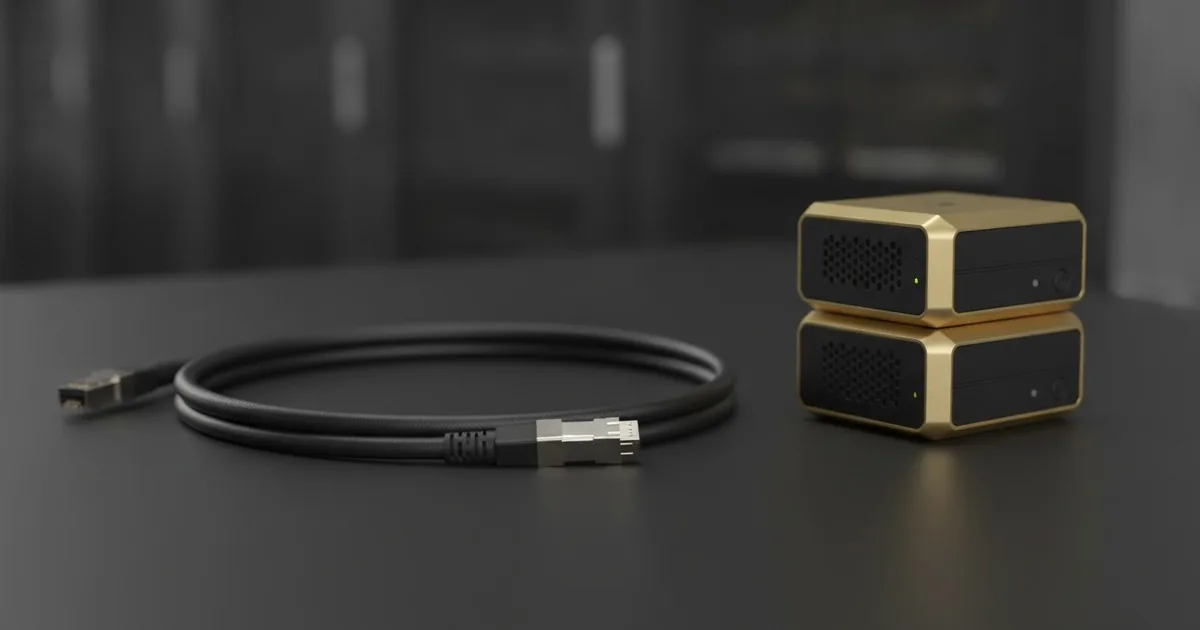
NVIDIA announced the DGX Spark 64GB on October 2, 2026: the same GB10 Grace Blackwell Superchip, the same ConnectX-7 networking, the same DGX OS and software stack as the original, with the unified memory halved to 64 GB and the price starting at $4,999. It goes on sale Friday, October 23 from Acer, ASUS, Dell, Gigabyte, HP and MSI. If you read that as "a cheaper Spark," the details say something more interesting: it is $1,000 more than the 128 GB model's original price, the 128 GB unit has all but vanished from stock at any price near its list, and NVIDIA's own pitch for the new configuration is that you will eventually want two of them.
That last part is why a cable company is writing the launch analysis. The 64 GB DGX Spark ships with two QSFP112 ports on the back and a clustering workflow in the box. Two units connect with one cable and pool their memory to 128 GB, which is exactly the memory of the single 128 GB machine most buyers originally went looking for. NVIDIA even said it out loud: two 64 GB systems clustered together do not just double the memory. For most of the people buying this new model, the pairing cable is not an accessory. It is the second half of the purchase decision, and it is the one part of the cluster you can actually order today, because the machines are sold out and the cable is on our shelf.
This post walks through what changed and what did not, who the 64 GB model is actually for, the pairing math in numbers we measured ourselves on real GB10 hardware, the exact cable a two-unit cluster needs, and what to do while you wait for the October 23 launch.
What the DGX Spark 64GB is, and what it is not
The DGX Spark is NVIDIA's compact desktop AI computer, built around the GB10 Grace Blackwell Superchip: a Blackwell GPU and a 20-core Arm CPU (ten Cortex-X925 and ten Cortex-A725 cores) sharing one coherent pool of unified memory. NVIDIA rates the platform at up to 1 petaFLOP of AI performance at FP4 precision and 273 GB/s of memory bandwidth, in a 1.2 kg box the size of a hardback book. The new 64 GB configuration keeps all of that. NVIDIA's announcement lists what carries over explicitly: the GB10 Grace Blackwell Superchip, DGX OS and the full NVIDIA AI software stack, "same as the 128GB model."
What changed is the memory line in the spec table. The NVIDIA product page now reads "64 GB LPDDR5X or 128 GB LPDDR5x, coherent unified system memory," with a footnote that the 64 GB configuration "is available exclusively through participating OEM partners." That footnote is the second structural difference, and it matters as much as the memory number: NVIDIA is not selling a 64 GB Founders Edition itself. The new model comes only from manufacturing partners, which means storage size, chassis design and final retail pricing can vary between systems, exactly as The PC Enthusiast points out in its coverage. If you order one, you are ordering an Acer, an ASUS, a Dell, a Gigabyte, an HP or an MSI, not a yellow-box NVIDIA unit.
One more thing the 64 GB model is not: a slower computer. Nothing in the published specification suggests the compute changed. The memory bandwidth stays at 273 GB/s, the CPU stays the same 20-core Arm complex, and Tom's Hardware confirms the ConnectX-7 RDMA NIC and the CPU carry over unchanged. You lose capacity, not speed, for any workload that fits.
Specs: 64 GB vs 128 GB, line by line
Here is the full published specification from NVIDIA's product page, with the memory difference and the model-size claims filled in from the announcement and the launch coverage.
- Architecture: NVIDIA Grace Blackwell, GB10 Superchip (both configurations).
- CPU: 20-core Arm, 10 Cortex-X925 + 10 Cortex-A725 (both).
- AI performance: up to 1 PFLOP at FP4 (both).
- Unified memory: 64 GB LPDDR5X on the new model; 128 GB LPDDR5X on the original. Coherent unified memory shared between the Grace CPU and the Blackwell GPU in both.
- Memory interface / bandwidth: 256-bit, 273 GB/s (both).
- Model capacity claim: up to 100 billion parameters on one 64 GB unit; up to 200 billion parameters on one 128 GB unit.
- Storage: up to 4 TB NVMe M.2 with self-encryption (platform spec; partner configurations vary).
- Networking: ConnectX-7 NIC at 200 Gbps plus 1x RJ-45 10 GbE, Wi-Fi 7, Bluetooth 5.4 (both).
- OS: NVIDIA DGX OS (both).
- Power: 240 W PSU, 140 W GB10 TDP (both).
- Size and weight: 150 x 150 x 50.5 mm, 1.2 kg (both).
- Availability: 64 GB from OEM partners on October 23, 2026; 128 GB units "available, stock varies."
Read as a table, this is the same machine with half the memory. That is the whole change, and it is worth being precise about it because the launch coverage is full of speculation about what else might have been cut. Nothing else in the spec moved.
The price: $4,999 against a moving target
The 64 GB DGX Spark starts at $4,999. The number that makes people do a double take is what it is being compared against. The original 128 GB DGX Spark launched at $3,999. In February 2026, NVIDIA raised the Founders Edition MSRP to $4,699, citing worldwide constraints in memory supply, in a pricing update the company posted for the unit it sells directly. The new 64 GB systems therefore start $1,000 above the 128 GB model's original price and $300 above its current adjusted MSRP, for half the memory of the machine they sit next to on the same page.
Is that as strange as it sounds? Only if prices stood still. VideoCardz notes the 128 GB model's price has since crossed $6,000, and Tom's Hardware reports that if you can find a 128 GB GB10 system in stock at all right now, you should expect to pay roughly $7,000 to $9,000, far above even NVIDIA's adjusted MSRP. Memory and storage pricing across the industry has been shifting hard, and NVIDIA's own announcement carries no promise the $4,999 number is permanent: Tom's points out that given "the ever-shifting prices of memory and storage right now, they might not stay there for long."
There is also a definitional wrinkle worth keeping straight. These are not directly equivalent products, as VideoCardz puts it: the $4,699 figure is NVIDIA's own Founders Edition price for a unit NVIDIA sells, while the $4,999 starting price belongs to OEM partner systems whose configurations and regional pricing the partners set themselves. Treat $4,999 as the floor, not the ceiling, and treat specific partner configurations as their own quotes.
What stays the same: GB10, ConnectX-7, DGX OS, and the software stack
The launch coverage keeps using the word "still," and each use marks something a buyer might have feared losing. The GB10 Grace Blackwell Superchip: still there. The 20-core Arm CPU complex: carries over unchanged, per Tom's Hardware. The 273 GB/s of shared memory bandwidth for CPU and GPU: unchanged. The ConnectX-7 RDMA NIC: "64 GB Sparks will retain the same ConnectX 7 RDMA NIC as their 128 GB stablemates," which is the sentence that makes everything later in this post possible. DGX OS and the NVIDIA AI stack: shipped ready from day one.
The software story is unchanged too, and it is a bigger part of the value than the spec sheet suggests. DGX Spark ships with the NVIDIA AI software stack working out of the box: NVIDIA Agent Toolkit, CUDA-X AI libraries, Nemotron open models, and the runtimes local-AI builders actually use, with NVIDIA naming Ollama, vLLM, PyTorch with CUDA, and, in its getting-started list, llama.cpp, Ollama, vLLM or LM Studio. The pitch is power-on to running models in minutes, on your desk, with your data, without sending a token to a cloud.
Blender is among the first major creator applications to support the platform, with a prebuilt installer NVIDIA says is coming soon. And for the agentic crowd, NVIDIA's build.nvidia.com/spark pages carry playbooks for the 64 GB devices, including serving LLMs with vLLM, running OpenClaw with a local LLM, and connecting multiple DGX Sparks for distributed workloads.
Who should buy the 64 GB model, and who should not
NVIDIA's own framing, in the announcement and in the coverage of it, is consistent: the strongest case for the 64 GB configuration is a builder who wants the GB10 platform, the software environment and the ConnectX-7 path, and whose work fits inside 64 GB. NVIDIA highlights local agents, inference, fine-tuning, data science and edge development as the day-one workloads.
What does 64 GB buy you in practice? NVIDIA's claim is models up to 100 billion parameters on a single device, with the agentic applications built on them running fully on device. In the real world you do not get to spend all 64 GB on weights. The model, the KV cache for your context window, the runtime, and your application all live in the same unified pool. An agent that runs around the clock, reviews code and carries out multistep tasks on a 32B-class model with a generous context window is a comfortable single-unit workload. A 70B model at a tight quantization fits. A 100B-class open model at aggressive quantization fits, with the headroom NVIDIA's claim assumes. What does not fit on one unit is the same class of 200B-parameter work the 128 GB model markets itself for, or long-context batching across several models at once.
Who should not buy it? Two groups. If you regularly fine-tune or run models near the 128 GB ceiling, the 64 GB unit is not your machine; the 128 GB configuration remains on sale for you, subject to that stock situation. And if you are comparing on price-per-GB against secondhand or leftover 128 GB stock at the old price, do the math on real listings, not on the launch MSRP, because in the current market those units are not selling at MSRP in either direction.
For everyone else, here is the honest summary: the 64 GB DGX Spark is the same computer with less headroom, sold at a price that assumes headroom is something you add later, over a cable.
The pairing math: why most DGX Spark 64GB buyers end up buying two
NVIDIA could have positioned a 64 GB desktop as an endpoint, a smaller box you buy instead of a bigger one. Instead, the announcement is built around the pair. The headline pitch for scaling is direct: two 64 GB units connected over their ConnectX-7 ports pool their memory to 128 GB, expand model support to up to 200 billion parameters, deliver twice the memory bandwidth, and in NVIDIA's own Qwen3.8 27B test delivered up to 1.7x the performance of a single system. NVIDIA even says it in one line: two 64GB units clustered together don't just double the memory.
Work the numbers on what that means for a buyer. One 64 GB unit claims up to 100B parameters. A pair pools to 128 GB, the exact memory of the single machine everyone wanted last year, and claims up to 200B parameters, the exact capacity claim the 128 GB model carries. The software does the work: NVIDIA Sync Cluster Assistant detects the connected units, validates their configuration and configures the ConnectX-7 network, and every node runs the same software stack, so nothing needs reconfiguring when you go from one unit to two.
The physics underneath that pairing is the part nobody else will tell you about, because we run a two-unit GB10 cluster ourselves and published the measurements. The ConnectX-7 in every GB10 box has two QSFP112 ports, each documented at 200 Gb/s. Two units connect with one cable, Port 0 to Port 0. Each QSFP112 port presents itself to Linux as two interfaces (enp1s0f0np0 and enP2p1s0f0np0) because it connects to the GB10 over two independent PCIe Gen 5 x4 links, and the full line rate only appears when traffic runs across both halves. On our own two-unit cluster, one cable measured 111.86 Gb/s on a single half and 196.08 Gb/s with both halves carrying traffic. That is the real 200 Gb/s fabric the Sync Cluster Assistant checks for: it verifies negotiated link speeds and alerts you if they are not 200 Gbit/s. Our bandwidth explainer walks through the full bits-versus-bytes arithmetic, including why 200 Gb/s is about 25 GB/s and how that compares with the 273 GB/s inside each unit.
So the pairing math for a 64 GB buyer looks like this: $4,999 now buys a complete GB10 platform that handles up to 100B parameters alone. The same $4,999 again later, plus one cable, turns it into the pooled 128 GB, up-to-200B-parameter, 1.7x-tested configuration NVIDIA is marketing, with a second CPU and a second GB10 chip doing the work. The single-cable pair is not a compromise. It is the upgrade path, and it is the reason the cable in the middle of it is the one part of the cluster you should think about before launch day.
The exact cable a two-unit 64 GB cluster needs
NVIDIA's announcement says two units connect "via a QSFP cable." That is true and incomplete, in the way that sends people to a search bar at 11 p.m. with two unopened boxes. Here is the precise answer, from NVIDIA's own documentation and from our own shelf.
The ConnectX-7 ports on a GB10 unit are QSFP112 cages. The cable NVIDIA's DGX Spark user guide lists for them is a passive QSFP112 400G direct-attach copper cable, and the documentation names the specification family by part number: the Amphenol NJAAKK0006 at 0.5 m and the Luxshare LMTQF022-SD-R at 400 mm and 30 AWG. A passive DAC is a copper cable with a QSFP112 connector crimped on each end and no electronics inside the plug, which is why it needs no power, no drivers and no firmware, and why the ConnectX-7 drives it directly at the full 200 Gb/s port rate.
The cable Petronella Technology Group, Inc. stocks is the Amphenol NJAAKR-0006: a 0.5 m QSFP112 passive DAC at 30 AWG, from the same Amphenol family, built to the NJAAKK0006 / LMTQF022-SD-R specification that NVIDIA's documentation names. To be exact about the claim, because a hardware launch is no place for loose language: NJAAKR-0006 is not the same part number as NJAAKK0006 or LMTQF022-SD-R, and we do not say it is. It is the 0.5 m length built to that same specification, and it links at the full 200 Gb/s port rate; we measured 196.08 Gb/s across one cable with both PCIe halves carrying traffic. Our part-number explainer decodes the whole NJAAKK family, including the 32 AWG 400 mm NJAAKK-N911 you will see on retail listings.
Plug it in Port 0 to Port 0 (the port nearest the RJ45 jack is Port 0 on every GB10 box we have opened), launch NVIDIA Sync Cluster Assistant, and it detects the cable, validates the configuration, checks the negotiated link speed, and configures the network for you. Two cables on one link is a documented non-optimization, by the way: NVIDIA's clustering guidance says to use only one cable per link, because connecting two devices with two cables will not improve performance.
Order today: Buy the DGX Spark cluster cable for $159, free US shipping. In stock now and shipping in 1 to 3 business days, so it is the one part of your two-Spark cluster you can have in hand before the machines ship.
The three-unit ring, and when you need a switch
NVIDIA's Sync Cluster Assistant documentation is unusually specific about topologies, and it is worth planning against it rather than against forum folklore. The assistant supports two to four DGX Spark devices, in two connection types that must never be mixed.
- Two units: one cable, direct connection, Port 0 to Port 0. Or one cable per device through a switch, two cables total.
- Three units: a switchless ring with three cables, in which each device connects to the other two, or one cable per device through a switch, three cables total. The ring is the elegant one: three boxes on a desk, three short cables, each unit using both of its QSFP112 ports, no switch to buy or power. Our port-by-port ring wiring guide walks the three links one at a time.
- Four units: a switch, required. Four direct-connect nodes would put two nodes two hops apart, and the assistant does not support a four-device direct topology at all: four devices use one cable per device through a switch, four cables total.
For the buyer deciding between one 64 GB unit and a small fleet, the ring is the sweet spot of this generation of hardware. Two units share one cable and pool 128 GB. Three units give you 192 GB pooled across a three-cable ring with every hop a single 200 Gb/s link. At four units you are buying a switch, and at that point you are building a fabric rather than a desk cluster, which is a different conversation. Our four-unit topology comparison works through exactly when the switch earns its cost.
One more rule from NVIDIA's docs that saves people money and regret: the Cluster Assistant "supports only DGX Spark and GB10 devices." It blocks clustering for anything else, so plan your cluster around GB10 units, with the cable lengths short and the topology clean.
The OEM 64 GB systems, and the same cable in every one of them
The 64 GB DGX Spark arrives from six launch partners: Acer, ASUS, Dell, Gigabyte, HP and MSI, starting October 23. NVIDIA's product page footnote says the 64 GB memory configuration is available exclusively through participating OEM partners, and the partners set their own configurations and regional pricing, which is why you will see chassis and storage differences across the badge on the front.
What does not vary is the network silicon. Every GB10 Grace Blackwell workstation carries the same NVIDIA ConnectX-7 network controller with the same two QSFP112 ports, and that is true of the 64 GB configurations the same way it is true of the 128 GB ones: the NIC is in the platform spec table, not in a partner's options list. It is also why the same cable fits every badge. The 0.5 m QSFP112 DAC we stock links an ASUS Ascent GX10 to a Dell Pro Max GB10 exactly as it links two DGX Sparks, and you can mix brands across one cable. We keep per-OEM pages so you can match the cable to your specific machine: the ASUS Ascent GX10 cable page, the Dell Pro Max GB10 cable page, the MSI EdgeXpert cable page, and the same pattern for HP ZGX Nano, Lenovo ThinkStation PGX, Acer Veriton GN100 and Gigabyte AI TOP ATOM from the hub page.
One practical note on buying a pair: if you are planning a two-unit cluster, buy the two units with the same storage and memory configuration from the same partner when you can. NVIDIA's Sync Cluster Assistant validates device configuration across the cluster, and matched systems make that validation boring, which is what you want infrastructure to be.
Availability, and what to do while you wait for hardware
Here is the state of the market as of this writing, early October 2026. The 64 GB DGX Spark is announced and dated: October 23, from Acer, ASUS, Dell, Gigabyte, HP and MSI, starting at $4,999. The NVIDIA product page says "coming soon" and points you at a notify-me form. GB10 systems across the board have been mostly sold out, and the 128 GB units that do surface sell at a large premium over MSRP. Tom's Hardware frames the whole launch as a lifeline in exactly those terms: a new configuration you can actually put an order against, in a market where the alternative is watching reseller listings.
If you have already decided on the pair, or even on the possibility of a pair, order the cable now rather than with the machines. This is not an upsell; it is sequencing. Every GB10 cluster that has ever failed to come up on day one in our experience failed on the physical layer, not the software: a cable that was not a QSFP112 passive DAC, a port that was not Port 0, a link that negotiated at half rate because only one PCIe half was carrying traffic. All of that is testable before your machines arrive, and all of it is documented in the two-Spark cabling guide and our public GB10 cluster guide. When the boxes land, you plug one cable between Port 0 and Port 0, launch Sync Cluster Assistant, and watch it validate a 200 Gbit/s link in minutes instead of troubleshooting at midnight.
Waiting on hardware also has a software half, and NVIDIA dated it: NVIDIA Sync Model Launcher is coming at the end of the month. It downloads and launches models like Qwen3.8 27B on a single DGX Spark or a cluster, configures the model to run across connected devices, makes it accessible from your laptop, and sets up OpenCode so you can start coding against your local model in the browser. The Cluster Assistant itself is already shipping in NVIDIA Sync, and it is the piece that turns cable-and-ports into a working cluster: it detects connected units, validates the configuration, and configures the ConnectX-7 network. If you want to see where our own two-Spark cluster lands against other local-AI hardware, the numbers are in our LLM benchmark leaderboards, and they will get a 64 GB row as soon as we can buy one.
So the waiting-on-hardware checklist is short. Reserve the machine or sign up for the OEM's notify list. Order the cable, which is in stock today. Read the cabling guide so Port 0, passive DAC and one-cable-per-link are already familiar words when the courier arrives. Then connect, cluster, and let Sync do its work.
Related reading
- DGX Spark Cluster Cable (QSFP112 400G DAC)
- What Cable Do I Need to Connect Two DGX Sparks?
- DGX Spark Cluster Cables In Stock: 0.5m QSFP112, $159
- DGX Spark Memory Bandwidth: 273 GB/s, and What 400G Adds
- DGX Spark Cluster: 4 to 8 Nodes, Switch vs Ring
FAQ
What does the 64GB DGX Spark change compared with the 128GB model?
The memory is halved to 64 GB of unified LPDDR5X and the price starts at $4,999. Everything that defines the platform carries over unchanged: the GB10 Grace Blackwell Superchip, the 20-core Arm CPU, 273 GB/s of unified memory bandwidth, the ConnectX-7 NIC with two 200 Gb/s QSFP112 ports, DGX OS and the full NVIDIA AI software stack. NVIDIA claims up to 100 billion parameters on one 64 GB unit versus up to 200 billion on the 128 GB model.
When does the 64GB DGX Spark ship and how much is it?
It goes on sale Friday, October 23, 2026, starting at $4,999, sold exclusively through participating OEM partners: Acer, ASUS, Dell, Gigabyte, HP and MSI. NVIDIA itself does not sell a 64 GB Founders Edition, and partner configurations and regional pricing can vary.
What can I run on a single 64GB DGX Spark?
NVIDIA's claim is models up to 100 billion parameters on one device, with the agents built on them running fully local. In practice you budget against the 64 GB pool after the model weights, the KV cache for your context window and your application overhead take their share, which is why quantized models in the 30B to 70B range are the comfortable target for always-on agent work.
What cable do two 64GB DGX Sparks need to cluster?
One 0.5 m QSFP112 400G passive DAC, plugged into a QSFP112 port on each unit, Port 0 to Port 0. The part we stock is the Amphenol NJAAKR-0006, a 0.5 m 30 AWG QSFP112 passive DAC built to the NVIDIA-approved specification: $159 with free US shipping, in stock and shipping in 1 to 3 business days. NVIDIA's Sync Cluster Assistant detects the cable and validates the 200 Gbit/s link.
How much memory do two clustered 64GB Sparks have?
Two 64 GB units pool to 128 GB of usable memory over the ConnectX-7 link, which is where NVIDIA's up-to-200-billion-parameter claim for a pair comes from, along with twice the memory bandwidth of one system. In NVIDIA's own Qwen3.8 27B test, two clustered 64 GB systems delivered up to 1.7x the performance of a single system.
Does the same cable fit the OEM 64GB systems from ASUS, Dell, HP, Lenovo, MSI, Acer and Gigabyte?
Yes. Every GB10 Grace Blackwell workstation, in 64 GB or 128 GB trim, carries the same NVIDIA ConnectX-7 controller with two QSFP112 ports, so the 0.5 m DAC built to the NVIDIA-approved spec links any two of them, and you can mix brands across one cable.
Can I cluster more than two DGX Sparks with cables?
NVIDIA's Sync Cluster Assistant supports two to four devices. Two units use one cable, Port 0 to Port 0. Three units form a switchless ring with three cables, each unit using both of its QSFP112 ports. Four units require a switch with one cable per device, and NVIDIA's guidance is to use exactly one cable per link, because doubling up cables does not improve performance.
Should I buy one 128GB Spark or two 64GB Sparks?
If one 128 GB system is in stock at a fair price and you need a single node with that memory, buy it. Two 64 GB units give you the same pooled 128 GB, plus a second CPU and second GB10 chip behind one cable, starting at $9,998 for the pair. If your work fits inside 64 GB, one unit is the entry point, and the cable is how you add the pooled 128 GB later without replacing anything.
Sources
- NVIDIA Blog: NVIDIA DGX Spark 64GB Gives Developers More Ways to Build and Scale Local AI (October 2, 2026)
- NVIDIA: Personal AI Supercomputer Powered by Blackwell | NVIDIA DGX Spark (product page and specifications)
- NVIDIA Sync User Guide: Cluster Assistant for Configuring a Multi-Node DGX Spark Cluster
- Tom's Hardware: Nvidia introduces 64GB DGX Spark to throw local AI fans a lifeline amid the RAMpocalypse (Jeffrey Kampman, October 2, 2026)
- VideoCardz: NVIDIA DGX Spark drops to 64GB memory but costs more than the original 128GB version (October 2, 2026)
- VideoCardz: NVIDIA officially raises DGX Spark Founders Edition MSRP to $4,699 (February 27, 2026)
- The PC Enthusiast: NVIDIA DGX Spark Gets a 64GB Model With the Full GB10 Platform (Peter Paul, October 2026)
Reference build sheets, a hardening checklist for open-weight model hosting and a data-sovereignty map for running AI on your own hardware.
Get the free guide