
Lenovo ThinkStation PGX Cluster Cable: 0.5m QSFP112 400G DAC
To cluster two Lenovo ThinkStation PGX units you need one cable: a 0.5m QSFP112 400G passive DAC, plugged into the ConnectX-7 QSFP112 port on each unit, Port 0 to Port 0. This ConnectX-7 cable is an alternative to Lenovo's own ThinkStation PGX QSFP Link Cable (4X91U42988) for a two-unit pair. It is built to the NVIDIA-listed Amphenol NJAAKK0006 / Luxshare LMTQF022-SD-R spec, sold here as the Amphenol NJAAKR-0006 (not the NJAAKK-N911 part number), in stock at petronellatech.com for $159 with free US shipping, shipping in 1 to 3 business days. Three units need three cables (the 3-pack ring kit is $435); NJAAKK-N911 vs NJAAKK0006: the part numbers decoded.
Outside the US? Checkout ships to US addresses only. Request a quote and we will reply with shipping options.
Read the Cable FAQTo cluster two Lenovo ThinkStation PGX AI workstations you need one 0.5m QSFP112 400G passive DAC cable across their dual 200Gb QSFP ports. The PGX is Lenovo's small-form-factor take on NVIDIA's GB10 Grace Blackwell platform, and its two QSFP ports expose the same ConnectX-7 controller as the DGX Spark, so it takes the exact cable NVIDIA approves in its Spark Stacking documentation (Amphenol NJAAKK0006 / Luxshare LMTQF022-SD-R spec). Petronella Technology Group, Inc. sells it at $159 with free US shipping, in stock, shipping in 1 to 3 business days. Prices and stock at other sellers change week to week, so compare ship dates as well as prices before you order.
Why buy this cable here instead of a generic compatible cable?
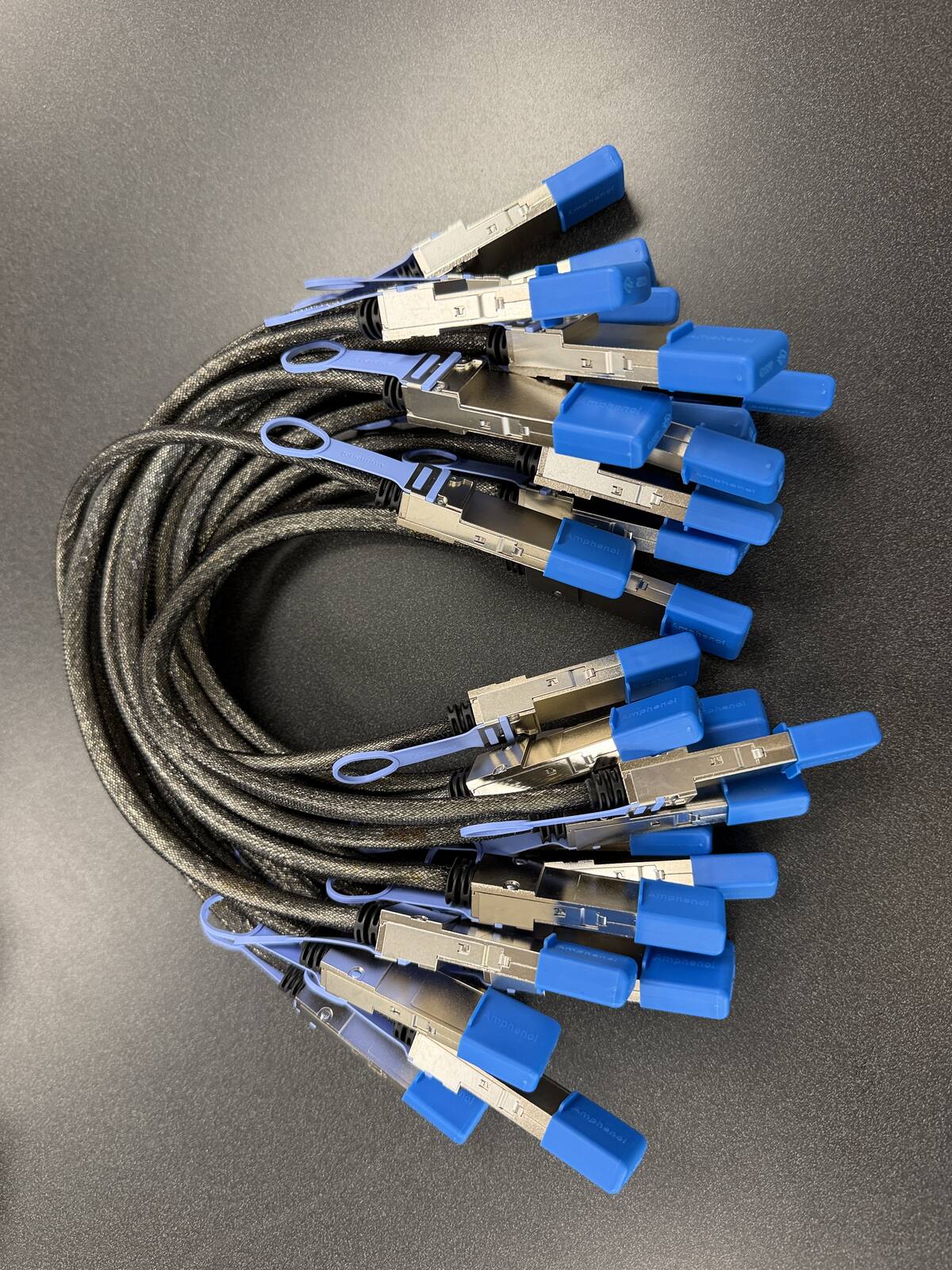
Is it a genuine Amphenol part? Yes. Each cable is factory sealed and jacket-stamped Amphenol AHSP P/N NJAAKR-0006, a 0.5m QSFP112 400G passive DAC built to the same NVIDIA Spark Stacking spec as the NJAAKK0006 / LMTQF022-SD-R references (not the same part number). The bag label is visible in the photos below.
Has it been tested in a GB10 cluster? We measured 196 Gb/s across a single 0.5m cable in our own GB10 cluster work, and the results are public in our free GB10 cluster guide on GitHub.
How fast does it arrive, and what if I change my mind? It is in stock in the US and ships in 1 to 3 business days with free US shipping. You can cancel any time before it ships for a refund less the payment processing fee (see our terms).
The ThinkStation PGX brings GB10 into Lenovo's enterprise workstation line, which is why IT teams tend to buy them through managed procurement and deploy them in pairs or small clusters rather than one at a time. When a second unit lands, the only part standing between two boxes and a working cluster is this cable, and it is the one component that does not come in the box. The PGX pairs a 20-core Arm CPU with a Blackwell GPU and 128 GB of unified LPDDR5x memory at up to 273 GB/s, then exposes clustering over two 200Gb QSFP ports.
| Cable | 0.5m QSFP112 400G passive direct-attach copper (DAC) |
| Approved spec | Amphenol NJAAKK0006 / Luxshare LMTQF022-SD-R (NVIDIA Spark Stacking docs) |
| Fits | Both 200Gb QSFP ports on the ThinkStation PGX ConnectX-7 controller |
| Platform | NVIDIA GB10 Grace Blackwell, 128 GB LPDDR5x, DGX OS |
| For two PGX units | One cable |
| For a three-node ring | Three cables (switchless, each box uses both ports) |
| Price | $159, free US shipping (in stock, ships in 1 to 3 business days) |
| Multipacks | 2-pack $299, 3-pack ring kit $435 (the three cables a switchless three-node ring needs), free US shipping, US addresses only |
| Works with | NVIDIA DGX Spark, Dell Pro Max GB10, ASUS Ascent GX10, HP ZGX Nano, Lenovo ThinkStation PGX, MSI EdgeXpert, Gigabyte AI TOP ATOM, Acer Veriton GN100; brands can be mixed in one cluster |
| Returns | Cancel free before it ships; after delivery, RMA within 30 days (15% restocking fee and $20 return shipping and handling fee) |
Clustering ThinkStation PGX units: how many cables and when you need a switch
Each ThinkStation PGX has two QSFP ports, so it follows the NVIDIA-documented GB10 topology: two units link directly with one cable, and three units form a switchless ring with three cables, each box using both ports for full pairwise connectivity. Three nodes is the switchless ceiling; with only two ports per unit, four or more PGX units need a 200G-class QSFP switch. Clustering pools memory so a model too large for one 128 GB node can run across the fleet. It is a capacity play, not a raw speed boost, since each link runs around 25 GB/s, which is exactly what memory-bound inference and fine-tuning on larger models needs. A PGX also clusters cleanly with a DGX Spark or any other OEM GB10 box, because they all share the ConnectX-7 NIC and QSFP port spec.
Where the two QSFP ports sit on the ThinkStation PGX
The ThinkStation PGX is a 150 x 150 x 50.5 mm box that weighs 1.2 kg, and every connector is on the rear panel. Lenovo's PSREF overview diagram numbers that panel in order: the power button, one USB-C port that doubles as the 240 W power input with DisplayPort alt mode, three more USB-C ports at USB 20 Gbps, an HDMI 2.1a port, a 10GbE RJ-45 jack, and finally the two QSFP cages rated at 200 Gbps each. The QSFP pair is the last item on the panel, beside the RJ-45. Lenovo labels the pair as being "for connecting two ThinkStation PGX units", which is exactly the job this cable does.
That layout matters for cable dressing because the cluster link shares one small face with the power lead, up to three display or USB-C leads, and the copper Ethernet uplink. A QSFP112 twinax DAC is thicker and stiffer than any of those, so route it first and let the thinner leads go around it. Bring the DAC out of the cage straight for the first few centimeters before it turns, keep it from crossing the USB-C power lead, and never let the cable carry the weight of the box above it. Passive DACs have a manufacturer-specified minimum bend radius, and a cable that has been kinked at the cage is the single most common cause of a link that flaps or negotiates below rate. It is also why cables bent past their minimum radius are excluded from returns. To release the cable, pull the latch tab straight back, then slide the connector out; do not rock it sideways in the cage.
Stacked, side by side, or on a rack shelf
Two PGX units stacked put their QSFP cages roughly five centimeters apart vertically, so the 0.5 m cable has far more length than the run needs. Form the excess into one gentle service loop behind the stack rather than a tight coil, and keep that loop clear of the ventilation openings on both chassis. Side by side on a bench, the cages sit about 15 cm or more apart depending on the gap you leave between the boxes, which is still comfortably inside the half-meter reach. On a 19-inch rack shelf, the 150 mm width means two units sit side by side with room for the loops; three across would consume the full inner width of the rails, so plan a three-node ring as a stacked pair plus one, or two shelves. In a stacked three-node ring, the longest run is the A-to-C cable spanning two chassis heights, about ten centimeters, which the same 0.5 m cable covers without strain.
Because all of the PGX's ports face one way, a wall or cabinet back panel directly behind the unit will force the DAC into a hard bend. Leave enough clearance behind the rear panel for the connector body plus a straight run before the cable turns. If your installation genuinely separates the machines by more than the cable reaches, tell us the port-to-port distance and Petronella Technology Group, Inc. will quote the correct longer build rather than a longer cable "to be safe"; every extra meter of passive copper costs signal margin.
ThinkStation PGX configurations, and which ones matter for clustering
Lenovo announced the ThinkStation PGX on October 13, 2025, and describes it as the first Lenovo workstation built on the NVIDIA GB10 Grace Blackwell Superchip. Everything below comes from Lenovo's PSREF specification sheet (dated July 1, 2026), the Lenovo Press product guide, and Lenovo's launch announcement; the full list of sources is at the end of this page.
| ThinkStation PGX as shipped | Verified specification | Effect on clustering |
|---|---|---|
| Processor | NVIDIA GB10 Grace Blackwell Superchip, 20-core Arm (10x Cortex-X925 + 10x Cortex-A725) | Same GB10 as every other GB10 workstation; no difference |
| GPU | NVIDIA Blackwell architecture, 5th-gen Tensor Cores, 4th-gen RT Cores, one NVENC and one NVDEC | Same GB10; no difference |
| Memory | 128 GB LPDDR5X unified, 256-bit, 273 GB/s | Fixed; pooled across nodes when clustered |
| Storage | 1 TB or 4 TB NVMe M.2 with self-encryption (PSREF lists up to 4 TB) | None for the link; only how many checkpoints each node keeps locally |
| Cluster ports | 2x QSFP, 200 Gbps each, on the onboard ConnectX-7 NIC | This is the interconnect; one 0.5 m QSFP112 DAC per link |
| LAN and wireless | 1x 10GbE RJ-45, Wi-Fi 7, Bluetooth 5.3 | Management and internet only; not used for the cluster link |
| Operating system | NVIDIA DGX OS (Lenovo Press also lists Ubuntu Linux Pro with NVIDIA Base OS) | Same DGX OS bring-up as the DGX Spark guide |
| Pre-installed software | NVIDIA AI software stack, CUDA 13, GB10 Dashboard, AI Workbench | NCCL and the RoCE drivers arrive with the stack |
| Power | 240 W USB-C power supply, included | Passive DAC draws no meaningful power |
| Security | TPM 2.0, self-encrypting NVMe, UEFI Secure Boot | No effect on the link |
| Chassis | 150 x 150 x 50.5 mm, 1.13 liter, 1.2 kg | Sets stacking and cable-loop geometry, above |
| Warranty | 1-year limited onsite service base; Premier Support and Keep Your Drive offered | Lenovo-specific; the passive cable carries no firmware |
Lenovo's own capacity claims are the clearest statement of why this cable exists: a single PGX handles models up to 200 billion parameters, and Lenovo states that two ThinkStation PGX systems linked over the integrated ConnectX-7 work with models up to 405 billion parameters. Lenovo's PSREF sheet goes further on topology and says the 200 Gbps ConnectX-7 NIC is for direct connection between two or three ThinkStation PGX systems, that connecting more than three requires a compatible QSFP switch, and that appropriate ConnectX-7 cable options are required for every configuration. That is the same two-then-three-then-switch rule NVIDIA documents for the DGX Spark Founders Edition.
What Lenovo changes, and what it does not
What Lenovo adds is around the silicon, not in it: a Lenovo-designed 1.13 liter chassis, Lenovo's choice of 1 TB or 4 TB self-encrypting storage, a Lenovo onsite warranty with Premier Support and Keep Your Drive options, and procurement through Lenovo's commercial channel rather than NVIDIA's store. The compute, the 128 GB memory, the ConnectX-7 NIC, and the two QSFP ports follow the GB10 reference, and Lenovo's PSREF sheet describes the NIC at the same 200 Gbps per port as NVIDIA's documentation. For a cluster buyer, that means nothing about the PGX changes the cable, the topology, or the bring-up procedure. The 1 TB versus 4 TB decision, the display outputs, and the Wi-Fi radio are irrelevant to the link. The only Lenovo-specific note is that Lenovo lists its own optional ConnectX-7 cable (part number 4X91U42988) and sells the PGX with cables sold separately; the cable on this page is built to the Amphenol NJAAKK0006 / Luxshare LMTQF022-SD-R spec that NVIDIA's DGX Spark documentation names for these ports, and it fits the same cages.
Setting up a ThinkStation PGX cluster: first boot to a verified link
The PGX ships with NVIDIA DGX OS and the NVIDIA AI software stack preloaded, so bring-up follows NVIDIA's DGX Spark clustering guide rather than anything Lenovo-specific. Finish the first-boot setup on each unit with the 10GbE jack or Wi-Fi connected to your normal network, apply system updates, and confirm both nodes run the same DGX OS release before you cable them. Mismatched releases and a badly seated cable are the two usual reasons a fresh pair refuses to run a distributed job.
Cable the same physical port on both units
NVIDIA's connect-two-sparks playbook says any QSFP interface works for a two-node link, but to use the same physical port on each device so that NCCL tests behave predictably. On the PGX that means the same cage position, left or right as you face the rear panel, on both boxes. Seat each end until the latch clicks. The connector is keyed and cannot go in upside down, and there is no transceiver to install because the DAC's ends are the transceivers.
Verify the ConnectX-7 link
NVIDIA's documentation uses ibdev2netdev to map the ConnectX-7 devices to their Linux interface names, and notes that each physical port shows two logical interfaces (for example enp1s0f1np1 and enP2p1s0f1np1 refer to the same port). Look for the interface marked (Up) after you cable the units. The standard Linux tools then confirm the state and speed:
ibdev2netdev
ip link show
ethtool <interface>
ibstat
ip link should show the interface in state UP; ethtool reports the negotiated speed, which on a GB10 node lands in the 200 Gb/s class because the ConnectX-7 runs two 100G lanes over a PCIe Gen5 x4 connection; and ibstat reports the link layer as Ethernet. That last point trips up people coming from InfiniBand clusters: NVIDIA states the DGX Spark QSFP ports support Ethernet configuration only, with a RoCE device behind each port for RDMA traffic. There is no subnet manager to run and no InfiniBand mode to switch into. In practice a healthy link measures 185 to 190 Gb/s of usable throughput, and our explainer on what 400G really means for a GB10 cluster walks through why that number sits about 11x below the 273 GB/s local memory bandwidth, and why clustering therefore adds model capacity rather than speed.
Addressing, MTU, and a first test
NVIDIA's playbook assigns each cluster interface a static address on a private subnet, using 192.168.100.10/24 on the first node and 192.168.100.11/24 on the second for the first interface, and a second subnet (192.168.101.x) if the second port is cabled. Set the addresses with your preferred tool (nmcli or ip addr add both work on DGX OS), then ping across them. For MTU, the default 1500 works and is what to test with first; if you raise it to a jumbo size for RoCE traffic, set the identical value on both ends of every link, because a mismatch produces a link that pings but stalls under load. Check the current value in the ip link show output. Once the ping succeeds, run a small NCCL test across the two nodes before you commit a long job. These steps are generic to every GB10 workstation; nothing in Lenovo's documentation adds or replaces them for the PGX.
If the link does not come up, the checklist is short because the cable is passive: reseat both ends until the latch clicks, confirm you cabled the same port position on both units, confirm both units are on the same DGX OS release, and check that the interface you addressed is the one ibdev2netdev reports as up. There is no cable firmware to suspect.
Order the ThinkStation PGX cluster cable
Free US shipping on every option. In stock, ships in 1 to 3 business days.
Need a PO or invoice for 5+ cables? Send the quantity and ship-to address through our cable quote form or call (919) 348-4912, and we send a Stripe invoice for your PO. Payment is due in full before the cables ship.
Outside the US? Checkout ships to US addresses only. Request a quote and we will reply with shipping options.
Mixing a ThinkStation PGX with other GB10 workstations
Enterprise teams rarely receive all their GB10 nodes from one vendor on one day, and the PGX often arrives through Lenovo procurement next to a machine somebody bought earlier from another channel. That is fine. Every GB10 workstation carries the same ConnectX-7 NIC with two QSFP ports, and the link between them is standard Ethernet, so a PGX clusters with a Dell Pro Max GB10 tower, an ASUS Ascent GX10, an MSI EdgeXpert, an HP ZGX Nano G1n, an Acer Veriton GN100, a Gigabyte AI TOP ATOM, or a DGX Spark Founders Edition over this same cable. Each of those pages covers where the QSFP ports sit on that particular chassis, which is the only thing that differs from box to box. Keep the DGX OS release aligned across the mixed pair and the software cannot tell whose logo is on the front.
The one thing to watch in a mixed stack is physical: chassis heights differ between OEMs, so the cage-to-cage distance changes, and a PGX stacked on a taller tower may put its QSFP ports higher than you expect. The 0.5 m cable still reaches any stacked or side-by-side desk arrangement, but measure before you rack mixed units on separate shelves.
Four or more PGX units: the switch changes the shopping list
Lenovo's PSREF sheet is explicit that connecting more than three ThinkStation PGX systems requires a compatible QSFP switch. Once a switch enters the design, you buy one cable per node running to the switch instead of one cable per link between neighbors, and the runs from a rack shelf to a switch elsewhere in the rack are often longer than half a meter. Count nodes for the next budget cycle, not just today, pick a switch whose port speed and form factor match the DACs, and decide where the switch physically sits relative to the stack before ordering cables. Petronella Technology Group, Inc. specs these builds routinely; send node count and rack layout through the cluster cable quote form on our hub page or call (919) 348-4912. For fleets that outgrow desk-side GB10 boxes entirely, the NVIDIA DGX systems we supply are the next step up, and our LLM benchmark leaderboards help size the model you are actually trying to run before you buy the fourth node.
Which cable option fits a ThinkStation PGX buyer
The PGX buyer we see most often is an IT or data science team that ordered two units together on a purchase order, because Lenovo's own two-node 405 billion parameter claim is the reason they bought a pair. For that team the single cable at $159 is the whole answer: one link, both units clustered, nothing else required. Buy the 2-pack at $299 ($149.50 per cable, save $19) if you are standing up two separate PGX pairs, or if you want a spare on the shelf so a damaged cable never idles a pair of workstations while a replacement ships. Buy the 3-pack ring kit at $435 ($145 per cable, save $42) when the third PGX is on order; it is the exact count for a switchless three-node ring, and it is the multipack we quote most often for this platform. Current bundle pricing and stock are kept up to date in our cluster cable stock and bundle post.
What is in the box, lead time, and returns
- In the box: one 0.5 m QSFP112 400G passive DAC per cable ordered, in its factory packaging with the part label visible. The QSFP ends are the transceivers; there is nothing else to buy, no software, and no firmware.
- Lead time: in stock and ships in 1 to 3 business days, with a tracking number emailed when it leaves.
- Shipping: free to US addresses. Outside the US, call (919) 348-4912 or use our contact page for a carrier quote before you order.
- Returns: cancel any time before it ships for a refund less the payment processing fee. Once it has shipped, a return needs an RMA within 30 days, you pay return shipping and handling, and the refund is the purchase price less a 15% restocking fee and a flat $20 return shipping and handling fee.
- Purchase orders: if your organization buys on POs, use the quote form on the hub page with quantity and timeline.
Where the $159 sits against the alternatives
| Source | Price | Shipping and availability |
|---|---|---|
| Petronella Technology Group, Inc. | $159 | Free US shipping; in stock, ships in 1 to 3 business days |
| Retail listings, same NVIDIA-approved spec | Varies by seller and week | Varies by seller |
| NVIDIA marketplace | Listed | Stock varies |
Every cable we ship is built to the NVIDIA-approved Amphenol NJAAKK0006 / Luxshare LMTQF022-SD-R reference spec, sold at retail as the NVIDIA DGX Spark Stacking DAC Cable, QSFP/CX7. It is the same passive electrical part whether it plugs into a ThinkStation PGX or any other GB10 workstation, which is why the GB10 cluster cable hub covers ordering, QSFP56 versus QSFP112, and the compatibility table once for every OEM. If the cluster is one part of a larger AI build-out, our AI services team can scope the model, the data pipeline, and the security controls around it.
Need five or more, a PO, or switch guidance for four or more PGX units? Request a bulk cluster cable quote.
Lenovo ThinkStation PGX cluster cable FAQ
What cable clusters two Lenovo ThinkStation PGX units?
Does the Lenovo ThinkStation PGX cluster with a DGX Spark or other GB10 box?
How many ThinkStation PGX units can I cluster without a switch?
Is the ThinkStation PGX cluster cable in stock?
Which rear port on the ThinkStation PGX takes the cluster cable?
Does the ThinkStation PGX come with a QSFP cable in the box?
Does the 1 TB or 4 TB ThinkStation PGX storage option change the cable I need?
Is the ThinkStation PGX cluster link InfiniBand or Ethernet?
What link speed should a ThinkStation PGX pair report after cabling?
What if I need to cancel or return my order?
Sources
- Lenovo PSREF, ThinkStation PGX specification sheet (July 1, 2026): psref.lenovo.com/syspool/Sys/PDF/ThinkStation/ThinkStation_PGX/ThinkStation_PGX_Spec.pdf
- Lenovo Press, ThinkStation PGX Product Guide (LP2321): lenovopress.lenovo.com/lp2321-thinkstation-pgx
- Lenovo StoryHub launch announcement (October 13, 2025): news.lenovo.com/all-new-lenovo-thinkstation-pgx-big-ai-innovation-in-a-small-form-factor/
- Lenovo PSREF accessory listing, ThinkStation PGX QSFP Link Cable 4X91U42988: psref.lenovo.com/accessory/4X91U42988
- NVIDIA DGX Spark User Guide, ConnectX-7 Networking (Spark Stacking): docs.nvidia.com/dgx/dgx-spark/spark-clustering.html
- NVIDIA DGX Spark Playbooks, Connect Two Sparks: github.com/NVIDIA/dgx-spark-playbooks/blob/main/nvidia/connect-two-sparks/README.md