A private AI voice agent processes spoken requests on hardware you control, keeping CUI and PHI off public cloud endpoints while meeting CMMC and HIPAA controls.
This guide is for compliance officers, IT leaders, and procurement teams at defense contractors and healthcare organizations evaluating voice-based AI. It covers the architectural requirements, the specific regulatory triggers that force on-premises deployment, and the decision criteria for selecting a model and hardware stack that satisfies audit requirements.
Key Takeaways
- Public cloud AI services handling CUI or PHI must meet FedRAMP Moderate or HIPAA Security Rule requirements; commercial productivity tenants generally do not satisfy these clauses.
- A private AI voice agent requires a defined data boundary, isolated network segmentation, and FIPS-validated cryptography to meet NIST SP 800-171 and DFARS 252.204-7012.
- Open-weight models like Llama 3.1, Mistral, and Qwen 2.5 can be deployed on single GPU workstations or clustered nodes depending on token volume and latency needs.
- Role-based access control, encryption at rest and in transit, and audit logging mapped to framework controls are mandatory layers, not optional features.
- Private deployment becomes cost-effective at high token volumes, with break-even points within 6-12 months at 500K+ tokens per day.
What a Private AI Voice Agent Is
A private AI voice agent is an artificial intelligence system that accepts spoken input, processes it through a large language model, and generates a spoken response, all running on infrastructure owned and operated by the organization. Unlike public cloud voice assistants, this system does not send audio, transcripts, or prompts to external servers. The model weights, inference engine, and data pipeline remain within the organization's physical or logical boundary.
The term "private" refers to the deployment model, not the model architecture. The underlying language model may be an open-weight model such as Llama 3.1, Mistral, Qwen 2.5, or Phi, selected based on benchmark performance for the specific use case. The critical distinction is that the inference stack is controlled by the organization, allowing enforcement of security controls that public cloud providers cannot guarantee for regulated data.
For regulated businesses, this distinction is not theoretical. The DoD CIO CMMC FAQ clarifies that encrypted CUI is still CUI, and encrypted CUI in a cloud still needs FedRAMP Moderate or equivalency. If your voice agent processes customer information that constitutes CUI, PHI, or financial records, the data boundary must be defined before deployment. The six-stage method for private AI deployment begins with defining that boundary: identifying what data types are involved and which frameworks apply, such as CMMC Levels 1, 2, or 3, HIPAA, or DFARS 252.204-7012.
How the Architecture Works
Hardware Sizing and Model Selection
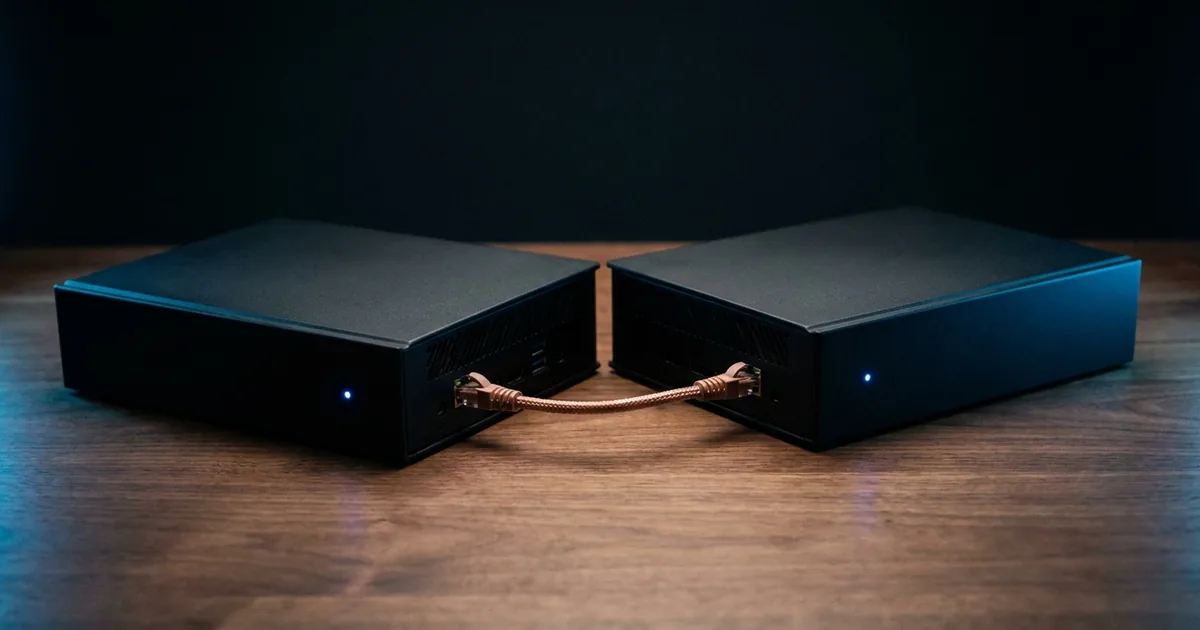
The hardware requirement depends on the model size and the expected token throughput. A 7B parameter model runs on a single NVIDIA A100 or H100 GPU. Larger models require 2-4 GPUs. For organizations that need to run larger models or handle high concurrency, reference cluster hardware includes GB10 Grace Blackwell nodes with 128GB unified memory each, clustered over a QSFP112 400G interconnect to pool 256GB for larger models. Single-box inference workstations are sized around RTX 5090, RTX 6000, or H200 class GPUs.
Model selection is not a one-size-fits-all decision. Supported open-weight model families include Llama 3.1, Mistral, Qwen 2.5, and Phi. Options are benchmarked against the client's specific use case before a recommendation is made. The blueprint also names DeepSeek as an open-weight model option. The choice affects latency, accuracy for domain-specific tasks, and the hardware footprint required.
Network Isolation and Security Layers
Once the hardware is sized, the cluster must be isolated. This means deploying on a segmented VLAN or a full air gap, depending on the sensitivity of the data and the requirements of the applicable framework. The blueprint hardening checklist covers network isolation, secrets handling, prompt and access logging, and egress control. These are not optional add-ons; they are the controls that auditors will verify.
On top of the network isolation, the system must enforce role-based access control, encryption at rest and in transit, and audit logging mapped to framework controls. NIST SP 800-171 requires FIPS-validated cryptography to protect the confidentiality of CUI. Encryption that is strong but not validated does not meet the requirement as written. This is a common failure point in private AI deployments: the encryption is technically strong, but it lacks the FIPS validation that the regulation explicitly requires.
Validation Before Production
The final stage of the six-stage method is validation against the framework controls before the system goes into production. This means testing that the access controls work as intended, that the audit logs capture the required events, and that the encryption is FIPS-validated. For CMMC Level 2, this involves assessing against the 110 security requirements of NIST SP 800-171 under 32 CFR Part 170. For Level 3, selected NIST SP 800-172 requirements are layered on top. For HIPAA, the system must support the Risk Analysis required under 45 CFR 164.308(a)(1)(ii)(A). There is no HHS-issued HIPAA certification, so the validation must be done by the organization or its assessor.
Regulatory Triggers That Force Private Deployment
Not every organization needs a private AI voice agent. The decision is driven by specific regulatory requirements that make public cloud deployment non-compliant. The three main triggers are CMMC, DFARS, and HIPAA.
DFARS 252.204-7012 requires a cloud service provider handling covered defense information to meet security requirements equivalent to the FedRAMP Moderate baseline. Commercial productivity tenants that have never been assessed against that baseline do not satisfy the clause. A DoD class deviation keeps DFARS 252.204-7012 on NIST SP 800-171 Revision 2 for now, but the direction is clear: covered defense information cannot be processed in a cloud environment that has not been assessed to the required standard.
HIPAA adds a different set of constraints. The HIPAA Security Rule at 45 CFR Part 164 requires a Risk Analysis under 45 CFR 164.308(a)(1)(ii)(A). If your voice agent processes patient information, that information is PHI, and the system must be designed to protect it in accordance with the Security Rule. Public cloud AI services may offer Business Associate Agreements, but the underlying infrastructure must still meet the technical safeguards required by the rule.
The NIST AI Risk Management Framework provides a voluntary framework for managing AI risks, but it does not replace the mandatory requirements of CMMC, DFARS, or HIPAA. The AI RMF 1.0 is being revised as part of the White House AI Action Plan, and NIST released a concept note for an AI RMF Profile on Trustworthy AI in Critical Infrastructure on April 7, 2026. This profile will guide critical infrastructure operators towards specific risk management practices when engaging AI-enabled capabilities. For regulated businesses, the AI RMF is a useful complement to the mandatory frameworks, not a substitute.
Evaluating Options and Decision Criteria
When evaluating private AI voice agent solutions, the decision criteria should map directly to your regulatory requirements. The table below summarizes the key considerations:
| Decision Factor | Public Cloud AI | Private AI Voice Agent |
|---|---|---|
| Data Boundary | Data leaves the organization's control | Data remains within the organization's physical or logical boundary |
| CMMC Compliance | Requires FedRAMP Moderate or equivalency for CUI | Can be assessed directly against NIST SP 800-171 and 800-172 controls |
| HIPAA Compliance | Requires BAA and technical safeguards verification | Direct control over Risk Analysis and Security Rule implementation |
| Cryptography | Depends on provider's FIPS validation | Organization selects and validates FIPS-validated cryptography |
| Audit Logging | Provider-controlled logs, limited granularity | Organization-controlled logs mapped to framework controls |
| Cost at Scale | Per-token API pricing | Break-even within 6-12 months at 500K+ tokens per day; 60-80% less annually at 5M+ tokens daily |
The cost consideration is important but secondary to compliance. At 500K+ tokens per day, private deployment breaks even within 6-12 months. At 5M+ tokens daily, costs are 60-80% less annually than equivalent API spend. For organizations with lower token volumes, the cost advantage may not materialize, and the decision should be driven primarily by regulatory requirements.
When evaluating vendors or building in-house, look for a solution that includes the full six-stage method: data boundary definition, hardware sizing, network isolation, model deployment, security layering, and validation. The free blueprint from Petronella Technology Group, Inc. walks through eight steps for hardening a private AI cluster, covering network isolation, secrets handling, prompt and access logging, and egress control. This blueprint is available to regulated teams who need a turnkey stack.
For organizations that need a deeper dive into the technical architecture, the private AI solutions page details the deployment options and the frameworks they map to. The private AI deployment guide provides a more detailed walkthrough of the six-stage method, including hardware sizing and model selection criteria.
Compliance is not a one-time event. The NIST AI RMF emphasizes continuous risk management, and the CMMC and HIPAA frameworks require ongoing monitoring and assessment. A private AI voice agent must be designed with this in mind: the audit logging must be continuous, the access controls must be reviewable, and the security posture must be assessable at any time. This is where the difference between a compliant deployment and a non-compliant one becomes clear.
For organizations operating in the defense industrial base or healthcare sector, the question is not whether to use AI, but how to use it in a way that satisfies the regulatory requirements. The 88% AI adoption rate reported by McKinsey in 2025 shows that AI is here to stay. The challenge is implementing it in a way that does not create new compliance liabilities. A private AI voice agent, deployed with the correct security controls and validated against the applicable frameworks, is one way to meet that challenge.
The compliance services from Petronella Technology Group, Inc. include support for CMMC, HIPAA, and DFARS assessments, as well as the design and deployment of private AI clusters that meet these requirements. The company's own private AI cluster runs ten-plus production AI agents on the enterprise private AI cluster, with the AI never closing a ticket on its own and never touching production systems without human authorization. Every action is logged for CMMC and HIPAA audit. This is the standard that regulated businesses should expect from their private AI deployments.
For organizations that need to understand the security implications of autonomous agents, the zero-trust AI guide covers how to secure autonomous agents in the modern enterprise. The AI governance consulting services help organizations establish the policies and procedures that govern AI use, including voice agents.
The decision to deploy a private AI voice agent is a technical, regulatory, and financial decision. The technical requirements are clear: open-weight models, isolated hardware, FIPS-validated cryptography, and audit logging. The regulatory requirements are equally clear: CMMC, DFARS, and HIPAA all have specific mandates that public cloud deployments may not satisfy. The financial requirements depend on your token volume, but the break-even point is well-documented. For regulated businesses, the answer to the question "should we use a private AI voice agent?" is often yes, provided the deployment is done correctly.
Step-by-Step Implementation Plan for a Private AI Voice Agent
Deploying a voice agent that handles sensitive data requires a structured approach. You cannot simply install software and hope for the best. The following sequence aligns with the six-stage method used to secure private AI clusters for regulated environments. Each step builds on the previous one to ensure the system is secure before it touches a single production record.
- Define the data boundary. Identify exactly which data classes the voice agent will process. For defense contractors, this means CUI. For healthcare, it is PHI. For finance, it is regulated financial records. You must also identify the specific frameworks that apply to that data, such as CMMC Levels 1, 2, or 3, HIPAA, or DFARS 252.204-7012. This step determines your entire security posture.
- Size the GPU hardware. A 7B parameter model runs on a single NVIDIA A100 or H100 GPU. If you anticipate needing larger models for complex voice interactions, you will require 2-4 GPUs. For high-volume inference, consider reference cluster hardware like GB10 Grace Blackwell nodes with 128GB unified memory each, clustered over a QSFP112 400G interconnect to pool 256GB for larger models. Single-box inference workstations can be sized around RTX 5090, RTX 6000, or H200 class GPUs depending on your throughput needs.
- Isolate the cluster. Place the AI infrastructure on a segmented VLAN or a full air gap. This physical or logical separation prevents the voice agent from accessing unrelated corporate systems. Network isolation is a critical control in the blueprint hardening checklist.
- Deploy open-weight models. Select models that fit your use case. Supported families include Llama 3.1, Mistral, Qwen 2.5, and Phi. Options are benchmarked against the client's specific use case before a recommendation is made. You control the inference stack, which is essential for maintaining sovereignty over the data.
- Layer security controls. Implement role-based access control, encryption at rest and in transit, and audit logging. These logs must be mapped to your framework controls. For example, NIST SP 800-171 requires FIPS-validated cryptography to protect the confidentiality of CUI. Encryption that is strong but not validated does not meet the requirement as written.
- Validate against controls. Before production, validate the system against the specific controls of your applicable framework. For CMMC Level 2, this means assessing the 110 security requirements of NIST SP 800-171 under 32 CFR Part 170. For Level 3, you layer selected NIST SP 800-172 requirements on top. Do not go live until this validation is complete.
This process ensures that the voice agent is not just a chatbot, but a compliant component of your broader security architecture. It turns a potential liability into a controlled asset.
Common Mistakes in Assessments and How to Avoid Them
During assessments of private AI deployments, we see recurring errors that compromise security or invalidate compliance claims. Avoiding these pitfalls saves time and prevents costly rework.
- Assuming encryption equals compliance. A common misconception is that if data is encrypted, it is safe. However, the DoD CIO CMMC FAQ clarifications state that encrypted CUI is still CUI. Furthermore, encrypted CUI in a cloud still needs FedRAMP Moderate or equivalency. If your voice agent sends data to a public cloud, you must ensure that provider meets these standards. If they do not, you are non-compliant regardless of encryption.
- Ignoring the FedRAMP baseline for defense data. DFARS 252.204-7012 requires a cloud service provider handling covered defense information to meet security requirements equivalent to the FedRAMP Moderate baseline. Commercial productivity tenants are rarely assessed against this baseline. If you use a SaaS voice agent for defense data, you are likely violating this clause. A DoD class deviation keeps DFARS 252.204-7012 on NIST SP 800-171 Revision 2 for now, but the requirement for FedRAMP Moderate equivalency for cloud providers remains a critical check.
- Skipping the Risk Analysis for HIPAA. The HIPAA Security Rule at 45 CFR Part 164 requires a Risk Analysis under 45 CFR 164.308(a)(1)(ii)(A). Many organizations skip this because they assume their vendor is "compliant." There is no HHS-issued HIPAA certification. You must perform your own analysis to determine how the voice agent handles PHI. If the agent processes PHI, it is part of your covered entity ecosystem.
- Overlooking shadow AI. IBM 2025 Cost of a Data Breach reports that 20% of breaches involved shadow AI. This happens when employees use unauthorized AI tools to handle sensitive data. If your voice agent is not the only AI tool in the building, you have a gap. You must enforce egress control and prompt logging to ensure all AI interactions are monitored and authorized.
- Failing to log every action. In a hybrid SOC environment, every action must be logged for CMMC and HIPAA audit. If your voice agent can take actions, such as updating a ticket or querying a database, those actions must be logged. The AI never closes a ticket on its own and never touches production systems without human authorization. If your implementation lacks this human-in-the-loop verification, you are exposing yourself to audit failure.
These mistakes are avoidable with proper planning and a clear understanding of the regulatory landscape. They are also the primary reasons why regulated businesses choose private deployment over public SaaS options.
How to Choose a Provider for Private AI Voice Agents
Selecting a partner to build and operate your private AI voice agent is a critical decision. You are not just buying software; you are buying a security posture. Use these questions to evaluate potential providers.
Can you demonstrate end-to-end private deployment?
Ask if the provider designs, builds, and operates private AI clusters end to end. You want a partner who can deliver the blueprint stack turnkey for regulated teams. They should be able to show you how they isolate the cluster on a segmented VLAN or full air gap. They should explain how they deploy open-weight models on an inference stack you control. If they rely on third-party APIs for core voice processing, they may not meet your data boundary requirements.
How do you map controls to specific frameworks?
A competent provider will not just claim "security." They will show you how their implementation maps to CMMC Levels 1, 2, or 3, HIPAA, and DFARS 252.204-7012. Ask for examples of how they handle FIPS-validated cryptography for CUI. Ask how they ensure their cloud providers, if any, meet FedRAMP Moderate baseline requirements. For HIPAA, ask how they support your Risk Analysis under 45 CFR 164.308(a)(1)(ii)(A). The answers should be specific, not generic.
What is your approach to human-in-the-loop oversight?
Autonomous AI is a risk in regulated environments. Ask how the provider ensures the AI never closes a ticket on its own. Ask how they ensure the AI never touches production systems without human authorization. In our own production environment, the hybrid SOC runs ten-plus production AI agents on the enterprise private AI cluster, but every action is logged for CMMC and HIPAA audit. Your provider should have a similar strict oversight model. They should provide audit logs that you can use for your own compliance evidence.
Do you offer a free scoping consultation?
Reputable firms understand that every environment is different. They should offer a free 30-minute scoping consultation to assess your specific needs. This allows you to discuss your data boundary, your framework requirements, and your hardware constraints without commitment. It also gives you a chance to evaluate their expertise and communication style. If a provider refuses to scope your project, they are not ready for a regulated engagement.
How Petronella Technology Group, Inc. Helps
Petronella Technology Group, Inc. is a cybersecurity, compliance, and private AI firm that serves regulated businesses and defense contractors. We do not just sell software. We design, build, and operate private AI clusters for regulated businesses end to end. Our team delivers the blueprint stack turnkey for regulated teams, ensuring that every component is secure and compliant from day one.
Our own private AI cluster and 24/7 AI-plus-human hybrid threat analysis stack underpin managed detection and response for defense industrial base and healthcare clients that cannot send CUI or PHI to a public-cloud SOC. This is not a theoretical capability. It is our daily operation. We understand the constraints of CMMC, HIPAA, and DFARS because we live in them every day. Our engineers are not just technicians; they are compliance experts who understand the nuances of FedRAMP Moderate baseline requirements and FIPS-validated cryptography.
We use ComplianceArmor®, our compliance documentation platform, to automate SSP authoring, POA&M tracking, and evidence repository organization. This means that when you deploy a private AI voice agent with us, the compliance documentation is handled in parallel. You do not have to scramble to create evidence for your auditors. We build the evidence into the deployment process.
Our founder, Craig Petronella, holds CMMC-RP, CCNA, CWNE, and an MIT AI certificate, with 30+ years of experience. He founded the company in 2002. Petronella Technology Group, Inc. is a Cyber AB Registered Provider Organization, RPO #1449, and every engineer assigned to a defense client holds the CMMC-RP credential. This ensures that your project is led by people who are certified in the very frameworks you need to satisfy.
We are BBB accredited with an A+ rating continuously since 2003. Our office is located at 5540 Centerview Dr Suite 200, Raleigh NC 27606. We deliver engagements remote-first across all 50 states, so you do not need to travel to work with us. We combine deep technical expertise with a proven track record in regulated industries.
Primary sources for this guide: AI Risk Management Framework.
Related reading
- CMMC Compliance: Gap Assessment, Levels 1 to 3
- Why a Private AI Appliance Secures Your Firm's Data
- Vmware Private AI Sovereign Cloud Alternative Ibm for Compliance
- Private AI Inference: Run LLMs On-Prem and Keep Data In-House
- Private AI vs Cloud AI: Enterprise Comparison 2026
Frequently Asked Questions
Can voice agent monitoring run in a private tenant or self-hosted deployment?
Yes, voice agent monitoring can run entirely in a private tenant or self-hosted deployment. In fact, for regulated businesses, this is often the required approach. A self-hosted deployment allows you to isolate the cluster on a segmented VLAN or full air gap, ensuring that no data leaves your controlled environment. This is critical for protecting CUI and PHI.
When you run the voice agent on your own infrastructure, you control the inference stack. You can deploy open-weight models like Llama 3.1, Mistral, Qwen 2.5, or Phi, and you can ensure that all encryption is FIPS-validated as required by NIST SP 800-171. This level of control is not possible with a standard SaaS offering.
What deployment model should regulated companies use for voice agent monitoring: SaaS, private tenant, or self-hosted?
Regulated companies should generally use a self-hosted or private tenant deployment model for voice agent monitoring. SaaS models are often incompatible with strict regulatory requirements like DFARS 252.204-7012, which requires FedRAMP Moderate baseline equivalency for cloud providers handling covered defense information. Most commercial SaaS voice agents do not meet this baseline.
A self-hosted deployment allows you to meet the specific controls of CMMC, HIPAA, and DFARS. You can implement role-based access control, encryption at rest and in transit, and audit logging mapped to your framework controls. This ensures that you remain compliant while leveraging the efficiency of AI voice agents.
How much does it cost to deploy a private AI voice agent?
Costs vary based on the scale of the deployment and the specific hardware required. A 7B parameter model runs on a single NVIDIA A100 or H100 GPU, while larger models require 2-4 GPUs. At 500K+ tokens per day, private deployment breaks even within 6-12 months. At 5M+ tokens daily, costs are 60-80% less annually than equivalent API spend. However, the true cost includes the security controls, compliance mapping, and ongoing maintenance.
The investment is justified by the reduction in compliance risk and the avoidance of potential breach costs. IBM 2025 Cost of a Data Breach reports a US average of $10.22M. A private deployment that prevents a breach or a compliance failure can save significantly more than the initial setup cost.
Do I need a human in the loop for a private AI voice agent?
Yes, a human in the loop is essential for regulated environments. The AI should never close a ticket on its own and should never touch production systems without human authorization. This ensures that every action is reviewed and approved by a qualified individual. It also provides a clear audit trail for CMMC and HIPAA compliance.
In our own production environment, the hybrid SOC runs ten-plus production AI agents, but every action is logged for audit. This model balances the efficiency of AI with the accountability required by regulators. It prevents the AI from making unauthorized changes that could lead to a security incident or a compliance violation.
Which open-weight models are best for voice agents?
Supported open-weight model families include Llama 3.1, Mistral, Qwen 2.5, and Phi. The best model depends on your specific use case. Options are benchmarked against the client's use case before a recommendation is made. For voice agents, you need a model that can handle natural language processing efficiently while running on your local hardware.
For high-volume deployments, you may need larger models that require 2-4 GPUs. For smaller deployments, a 7B parameter model on a single GPU may be sufficient. The key is to choose a model that fits your hardware constraints and your performance requirements. We can help you benchmark these options against your specific needs.
How do I ensure my private AI voice agent is HIPAA compliant?
To ensure HIPAA compliance, you must perform a Risk Analysis under 45 CFR 164.308(a)(1)(ii)(A). There is no HHS-issued HIPAA certification, so you cannot rely on a vendor's claim of compliance. You must assess how the voice agent handles PHI and ensure that all security controls are in place. This includes encryption at rest and in transit, role-based access control, and audit logging.
Private deployment helps with HIPAA compliance by keeping PHI within your controlled environment. You can ensure that the data is encrypted with FIPS-validated cryptography and that access is restricted to authorized personnel only. This reduces the risk of a breach and helps you meet the requirements of the HIPAA Security Rule.
If you are ready to move forward, call Penny, our AI assistant, at 919-348-4912, or use our contact form to schedule a free 30-minute scoping consultation. We will assess your specific needs and provide a clear path to a compliant, private AI voice agent deployment.
Reference build sheets, a hardening checklist for open-weight model hosting and a data-sovereignty map for running AI on your own hardware.
Get the free guide