
AI Workflow Automation: Intelligent Process Automation for Your Business
AI workflow automation replaces brittle, rule-based processes with intelligent systems that read unstructured documents, route approvals based on context, sync data across dozens of applications, and handle exceptions without human intervention. Petronella Technology Group, Inc. designs, builds, and maintains custom AI automation pipelines that reduce cycle times by up to 80 percent and eliminate the manual handoffs that slow your operations. Our team combines 24+ years of IT infrastructure experience with modern machine learning to deliver AI process automation that actually works in production, not just in demos. For a deeper walkthrough, read AI Automation Use Cases That Deliver Real ROI.
Key Takeaways: AI Workflow Automation
- Up to 80% faster cycle times by replacing manual handoffs, copy-paste data entry, and exception queues with intelligent automation that runs 24/7.
- Unstructured data processing with ML models that read invoices, contracts, emails, and handwritten forms without requiring templates or fixed layouts.
- Self-improving accuracy because AI workflow models learn from human corrections and get better over time without developer effort.
- No per-task fees. Petronella Technology Group builds your automation once. Marginal cost of 10x volume is near zero, unlike Zapier or UiPath per-execution pricing.
- Enterprise-grade security with encryption at rest and in transit, RBAC, full audit logging, and automatic PII/PHI/CUI detection built into every pipeline.
- 4 to 8 week production timeline for a single workflow. Complex multi-system implementations with compliance requirements typically take 8 to 12 weeks.
What Is AI Workflow Automation?
AI workflow automation is the use of artificial intelligence and machine learning to orchestrate multi-step business processes that previously required manual human effort. Unlike traditional automation tools that rely on fixed if-then rules and structured data inputs, AI workflow automation can interpret unstructured information, make context-aware decisions, handle exceptions intelligently, and improve its own accuracy over time. The technology combines natural language processing, computer vision, predictive analytics, and decision models into pipelines that move work through your organization faster and more accurately than any manual or rule-based approach. For a deeper walkthrough, read AI Automation: Transform Your Business Operations. For a deeper walkthrough, read AI Automation Benefits: Faster, Smarter, Leaner.
Consider a typical accounts payable workflow. An invoice arrives as a PDF email attachment. A human opens the email, downloads the file, reads the invoice, types the line items into the accounting system, looks up the purchase order for a match, flags discrepancies, routes the invoice for approval, and follows up when approvals stall. Every one of those steps is a candidate for AI automation. An AI workflow reads the email, extracts the attachment, classifies the document type, pulls structured data from the unstructured PDF (regardless of format or layout), matches it against open purchase orders, flags discrepancies with confidence scores, routes the invoice to the correct approver based on amount thresholds and department rules, and automatically escalates stalled approvals. The human only gets involved when the AI encounters a genuinely ambiguous case that falls below its confidence threshold. For a deeper walkthrough, read AI Automation Tools: Streamline Every Workflow.
What makes this different from tools like Zapier or Power Automate is the intelligence layer. Those platforms connect structured data between applications using predefined rules. They work well for simple triggers: "When a form is submitted, create a row in a spreadsheet." But they break down when inputs are unstructured, when decisions require judgment, or when exceptions need contextual handling. AI workflow automation handles all of those scenarios because it uses trained models rather than static rules. When the AI encounters an invoice format it has never seen before, it still extracts the data correctly because its models understand document structure at a conceptual level rather than relying on template matching.
Petronella Technology Group, Inc. builds AI workflow automation for businesses that have outgrown rule-based tools or need to automate processes that involve unstructured data, complex decision logic, or compliance requirements. Our team has implemented intelligent automation across industries including healthcare, legal, financial services, manufacturing, and technology. We combine custom AI development with deep infrastructure expertise to deliver workflows that are not only intelligent but also secure, observable, and maintainable in production environments. Every pipeline we build includes monitoring, alerting, audit logging, and documented runbooks so your team can operate the automation confidently after handoff. For a deeper walkthrough, read AI Automation: Boost Efficiency Across Industries.
See AI Workflow Automation in Action
Craig Petronella discusses how businesses use AI to eliminate manual bottlenecks and build intelligent automation that improves over time.
What AI Workflow Automation Delivers
Machine learning replaces brittle if-then rules with intelligent processes that learn from corrections and adapt to new scenarios without code changes.
Document Processing Automation
AI reads invoices, contracts, forms, and correspondence in any format. Models classify document types with 98%+ accuracy and extract structured data from unstructured inputs. When the AI encounters an unfamiliar format, it applies its understanding of document structure to pull the correct fields. Human corrections feed back into the model, so accuracy improves continuously. Petronella builds custom AI agents that handle your specific document types and business rules.
Approval Chain Orchestration
Multi-level routing based on amount thresholds, department rules, risk scores, and historical patterns. AI auto-escalates stalled approvals and optimizes reviewer assignment based on workload and expertise. The system learns which approvers are fastest for different request types and adjusts routing accordingly. Approval workflows integrate with Slack, Teams, email, and mobile notifications so reviewers can act without logging into a separate system.
Cross-System Data Sync
Bidirectional data pipelines between CRM, ERP, HRIS, databases, and SaaS applications. AI resolves field conflicts, deduplicates records, normalizes formats, and maintains a single source of truth across your entire tech stack. Most businesses run 10 to 30 applications that need to share data. Petronella builds sync pipelines that handle the transformations, validations, and conflict resolution that manual data entry currently requires.
Intelligent Exception Handling
When data falls outside tolerance, AI classifies the exception type, attempts auto-resolution based on historical outcomes, and routes only genuinely ambiguous cases to humans. Traditional automation stops at the first unexpected input. AI workflow automation resolves 60 to 80 percent of exceptions automatically, dramatically reducing the queue of items that need manual review. Each resolution the AI handles feeds back into its training data.
Compliance Workflow Automation
Automated evidence collection, gap analysis, control testing, and audit preparation for HIPAA, CMMC, SOC 2, PCI DSS, and NIST 800-171. AI monitors your environment continuously and flags compliance drift before it becomes a finding. Petronella's compliance automation works alongside our managed IT services to ensure controls stay in place between audits.
Custom API and Webhook Pipelines
Event-driven automation triggered by webhooks, API calls, scheduled jobs, or database changes. Custom connectors for legacy systems that lack modern APIs. Petronella builds adapters that translate between old and new systems, so you do not need to replace legacy applications to automate the workflows that depend on them. Every pipeline includes retry logic, dead-letter queues, and alerting for failed executions.
AI Workflow Automation vs. Traditional RPA and Rule-Based Tools
Traditional RPA tools like UiPath and rule-based connectors like Zapier serve different purposes than AI workflow automation. Here is how they compare across the factors that matter most for production business processes. For where this is heading, read how RPA gives way to agentic enterprise workflows.
Business Processes That Benefit Most from AI Automation
Accounts Payable and Receivable. Invoice processing is one of the most common starting points for AI workflow automation because it combines unstructured document inputs (invoices arrive in dozens of different formats), multi-step approval chains, cross-system data entry (accounting, ERP, bank), and high volume. AI reads the invoice, matches it to a purchase order, flags discrepancies, routes for approval, and posts to your accounting system. Companies that automate AP with AI typically see processing times drop from 5 to 10 days down to hours, with error rates falling below 1 percent.
Employee Onboarding. A new hire triggers a chain of 30 to 50 tasks across HR, IT, facilities, security, and the employee's direct team. Provisioning accounts, ordering equipment, assigning training, setting up payroll, creating badges, and scheduling orientation all happen in different systems with different owners. AI workflow automation coordinates the entire sequence, assigns tasks to the right people, tracks completion, sends reminders, and escalates blockers. The new employee experience improves because nothing falls through the cracks.
Customer Service Routing and Response. Support tickets, emails, and chat messages arrive in unstructured text that varies widely in tone, topic, and urgency. AI classifies incoming requests by category, urgency, and sentiment. It routes tickets to the right specialist, suggests responses from your knowledge base, drafts reply templates for agents, and automatically resolves common requests like password resets or status inquiries. First-response times typically drop by 50 to 70 percent.
Contract Review and Management. Legal teams spend significant time reviewing contracts for non-standard terms, missing clauses, and compliance requirements. AI reads contracts, extracts key terms (renewal dates, payment terms, liability caps, SLA commitments), flags deviations from your standard playbook, and routes flagged sections for legal review. The full contract still gets reviewed, but the AI highlights what needs attention so lawyers spend their time on judgment calls rather than reading boilerplate.
Compliance Evidence Collection. Regulated organizations spend thousands of hours per year collecting evidence for audits. AI automation continuously pulls evidence from your systems (access logs, configuration states, training records, policy acknowledgments), organizes it by control requirement, flags gaps, and prepares audit-ready packages. Petronella combines this automation with our AI-powered SOC services and compliance consulting to deliver a fully managed compliance program. Our clients report spending 70 percent less time on audit preparation compared to their previous manual processes. For a deeper walkthrough, read Compliance AI: From Manual Checklists to Automation.
How Petronella Implements AI Workflow Automation
Every AI automation project follows a structured six-phase process. You get working automation in production within 4 to 12 weeks depending on complexity, with measurable results from the first sprint.
-
Process Mapping and Data Analysis
We document your current workflow step by step, identifying every handoff, decision point, data source, and exception path. We analyze a representative sample of your actual data (invoices, tickets, documents, whatever the workflow processes) to understand the variation and complexity the AI will need to handle. This phase produces a detailed process map, a data analysis report, and a prioritized automation plan showing which steps deliver the highest ROI when automated.
-
System Access and Integration Setup
We establish secure connections to every system involved in the workflow. This includes APIs, databases, file storage, email systems, chat platforms, and any legacy applications. For systems without modern APIs, we build custom connectors using screen capture, database queries, or file system monitoring. Every integration is secured with service accounts, API keys, and encrypted credentials stored in a vault.
-
Build Pipeline and Train ML Models
We build the automation pipeline and train machine learning models on your actual data. Document classification models learn your specific document types. Extraction models learn your field layouts. Decision models learn your routing rules and exception patterns. We use your historical data for initial training and then refine with a human-in-the-loop validation phase where your team reviews and corrects the AI's outputs on live data.
-
Parallel Validation Against Manual Process
The AI runs alongside your existing manual process for 2 to 4 weeks. Every AI output is compared against the human output. We measure accuracy, speed, and exception handling quality. Any discrepancies are analyzed, and the models are retrained. This parallel run eliminates risk because the manual process continues to handle real work while the AI proves itself. We do not cut over until the AI matches or exceeds human accuracy on your actual production data.
-
Production Cutover
Once the AI has proven its accuracy during parallel validation, we switch production traffic to the automated pipeline. The cutover is gradual. We start with low-risk, high-volume items and progressively expand scope. Human reviewers remain in the loop for the first 30 days, spot-checking AI outputs at a sampling rate that decreases as confidence builds. Monitoring dashboards show real-time accuracy, throughput, and exception rates so you can see the automation working.
-
Continuous Optimization and Support
After cutover, Petronella monitors the pipeline, investigates any accuracy drops, retrains models when your business processes change, and adds new capabilities as your needs evolve. AI workflow automation is not a set-and-forget deployment. Business processes change, new document formats appear, new systems get added, and new exception types emerge. Petronella provides ongoing management so your automation stays current and continues improving.
The Technology Behind Intelligent Automation
Petronella builds AI workflow automation using a combination of open-source and commercial AI components selected for each client's specific requirements. We do not force a single platform. Instead, we pick the best tool for each step in the pipeline and integrate them into a cohesive system.
For document processing, we use computer vision models trained on your specific document types. These models understand spatial relationships on a page, so they can extract data from invoices, forms, contracts, and correspondence regardless of layout. Unlike template-based OCR that breaks when a vendor changes their invoice format, our ML models generalize across formats because they understand what an invoice looks like conceptually rather than memorizing pixel positions.
For natural language understanding, we deploy large language models through retrieval-augmented generation (RAG) architectures that ground AI responses in your actual business data. This means the AI can answer questions about your contracts, policies, and procedures using your real documents as source material rather than making things up. RAG architectures are critical for business workflow automation because accuracy matters and hallucinated data is not acceptable.
For workflow orchestration, we use event-driven architectures that respond to triggers in real time. When an invoice hits your email, the pipeline starts automatically. When a status changes in your CRM, downstream systems update within seconds. When an approval is granted, the next step fires immediately. We build on platforms like n8n, Apache Airflow, and custom event buses depending on the complexity and latency requirements of the workflow.
Security is built into every layer. All data is encrypted at rest and in transit. Access to AI models and training data is controlled through role-based access controls. Every pipeline execution produces a complete audit trail showing what data was processed, what decisions were made, and what actions were taken. Automatic PII, PHI, and CUI detection ensures that sensitive data is handled according to your compliance requirements. For clients in regulated industries, we deploy automation on private infrastructure so customer data never leaves your controlled environment.
Why Choose Petronella Technology Group for AI Workflow Automation


Led by Craig Petronella, CMMC Registered Practitioner (RP)
Craig Petronella founded Petronella in 2002 and has spent 24+ years helping businesses eliminate inefficient processes through technology. He is the author of 8+ published books including Beautifully Inefficient, which examines why business processes stay broken and how to fix them with automation, AI, and better systems thinking. Craig also hosts the Encrypted Ambition podcast, where he interviews business leaders and technologists about cybersecurity, compliance, and the real-world impact of AI on operations.
Petronella is not a software reseller or a consulting-only firm. We build AI automation on real infrastructure using n8n, custom APIs, AI agents, and production ML pipelines. We also provide the cybersecurity, compliance, and managed IT that keeps your automation secure and compliant. That full-stack approach, AI automation plus security plus compliance under one roof, is what separates Petronella from firms that only build automations or only do security.
Real AI, Not Just Zapier Integrations
Petronella deploys production machine learning models, custom AI agents, n8n orchestration workflows, and RAG architectures. We build on your own secure infrastructure rather than chaining together SaaS tools with per-execution fees. The automation we deliver processes unstructured data and makes intelligent decisions that rule-based tools simply cannot handle.
Security and Compliance Built In
Every automation pipeline includes encryption, RBAC, audit logging, and sensitive data detection from day one. Craig holds CMMC-RP certification, Petronella is a Registered Provider Organization (RPO), and Petronella's compliance team reviews every workflow design against HIPAA, CMMC, SOC 2, and PCI DSS requirements before deployment. You do not need a separate security vendor to protect your automation.
Full-Stack: AI + Cybersecurity + IT
Most automation firms hand you a workflow and walk away. Petronella provides the entire stack: custom AI development, network infrastructure, endpoint protection, compliance management, and ongoing support. When your automation touches regulated data or critical systems, you need a partner who understands both the AI and the security implications.
Raleigh-Based with Local Support
Petronella is headquartered at 5540 Centerview Dr., Suite 200, Raleigh, NC 27606. We serve clients nationally but provide hands-on local support for Triangle-area businesses. With 24+ years serving clients and a BBB A+ rating since 2003, Petronella has the track record and stability that startups and enterprises both require from an automation partner.
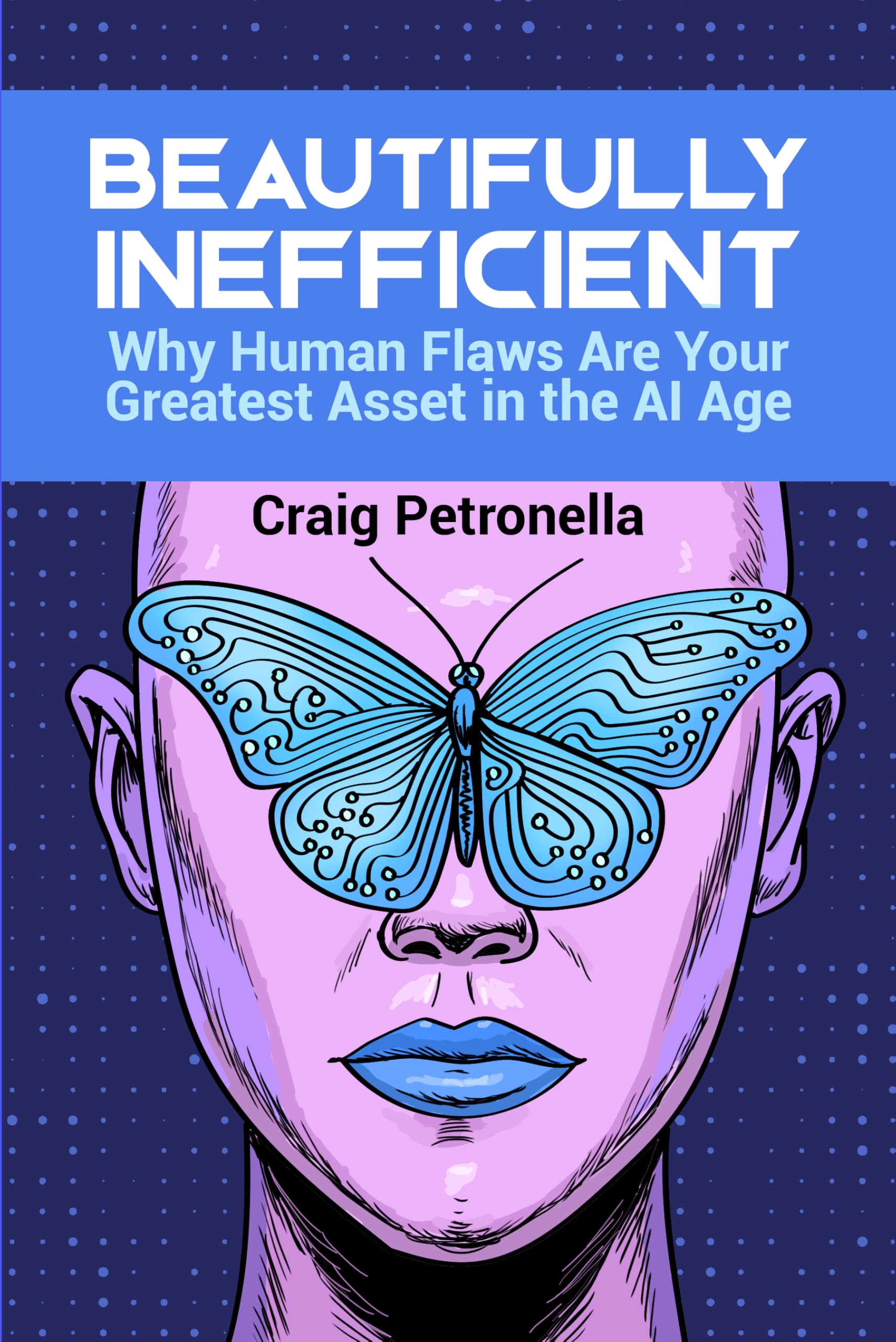
Recommended Reading: Beautifully Inefficient
Craig Petronella's book on business process optimization explores why organizations cling to manual workflows that waste time and money, and how to systematically identify, prioritize, and automate the processes that matter most. If you are evaluating AI workflow automation for your business, this book provides the strategic framework for deciding what to automate first and how to measure success. For a deeper walkthrough, read AI Automation: Workflow Optimization.
Browse All BooksAI Automation Services by Industry
AI workflow automation applies across any industry where manual processes create bottlenecks. Here are the sectors where we see the highest demand and the fastest ROI.
Healthcare and Life Sciences
Patient intake, insurance verification, prior authorization, claims processing, clinical documentation, and HIPAA-compliant data workflows. Healthcare organizations face strict regulatory requirements and high volumes of unstructured documents. AI automation handles both while maintaining full audit trails and PHI protections required by HIPAA.
Financial Services
Loan origination, KYC/AML compliance, transaction monitoring, account reconciliation, and regulatory reporting. Financial institutions process enormous volumes of documents and transactions with zero tolerance for errors. AI automation reduces processing times while improving accuracy and maintaining the audit trails regulators require.
Legal and Professional Services
Contract review, document management, billing automation, matter intake, and conflict checking. Law firms and professional services companies bill by the hour, which means manual administrative work directly reduces revenue-generating capacity. AI automation handles the administrative overhead so professionals spend their time on client work.
Manufacturing and Distribution
Purchase order processing, inventory management, quality control documentation, supplier communications, and shipping logistics. Manufacturing workflows often span dozens of systems and involve high volumes of purchase orders, invoices, and shipping documents in varying formats. AI automation connects the entire supply chain data flow.
AI Workflow Automation: Frequently Asked Questions
How is AI workflow automation different from Zapier or Power Automate?
What processes benefit most from AI workflow automation?
Can AI workflow automation integrate with our existing software?
How long does implementation take?
Is AI workflow automation secure enough for regulated industries?
What happens when the AI makes a mistake?
How much does AI workflow automation cost?
Do we need a data science team to maintain AI workflows?
Can AI workflow automation handle our compliance requirements?
What is the difference between AI workflow automation and AI agents?
Ready to Automate Your Most Time-Consuming Workflows?
Free workflow assessment. We map your highest-impact processes, estimate savings, and provide a transparent scope and timeline. No obligation, no sales pressure. Just a clear picture of what AI workflow automation can do for your business and how fast you will see results.
919-348-4912Petronella Technology Group, Inc. · 5540 Centerview Dr., Suite 200, Raleigh, NC 27606