Update, July 17, 2026: these two cards are no longer for sale. We decided to keep them and put them back to work in our own AI infrastructure. Thank you to everyone who reached out. If you are planning a local AI build of your own, call Penny at 919-348-4912 or book a free AI strategy consultation with Craig. The original listing follows for reference.
We are selling two NVIDIA GeForce RTX 5090 32GB graphics cards. Both are used, both are fully tested, and both work perfectly. One came out of a Threadripper Pro workstation that we recently sold, and the other has been running in an office machine here at Petronella Technology Group, Inc. We have rotated them out of service, and rather than letting them sit on a shelf, we are passing them to someone who wants serious local AI horsepower without paying the eye-watering markups on new cards.
Quick summary: two RTX 5090 32GB cards, the PNY listed at $4,599 and the MSI at $4,999, sold as-is with free US shipping. Both have since been withdrawn from sale and returned to service in our own fleet.
Why we are selling two perfectly good RTX 5090s
Petronella Technology Group runs a fleet of GPU servers and AI workstations for our own research, for client work, and for the on-premise AI systems we build. Hardware moves through that fleet constantly. We upgrade, we consolidate, and we retire machines as newer accelerators come online. These two RTX 5090 cards are a product of that churn, not of any defect.
The first card is a PNY GeForce RTX 5090 32GB ARGB Overclocked Triple Fan that lived in a Threadripper Pro workstation. That box was sold, and the card came home with us. The second is an MSI GeForce RTX 5090 32GB Ventus 3X OC that has been quietly doing inference work in an office machine. Both are healthy, both have been stress-tested, and both are ready for a new owner. We would rather see them put to work than collect dust.
We have done this before. Earlier this year we sourced a small lot of cluster cables for our own GB10 boxes and sold the surplus to the AI builder community at a fair price. This is the same idea: useful hardware, honest condition, no nonsense.
Local AI is the future, and it is already here
For two years the default assumption was that artificial intelligence lived in someone else's data center. You sent your prompt to a cloud endpoint, you paid per token, and your data left your building. That model is convenient, and for plenty of use cases it is fine. But it is no longer the only option, and for a growing list of organizations it is the wrong option.
Local AI means running the model on hardware you own and control. A single RTX 5090 with 32GB of fast GDDR7 memory is enough to run capable open-weight large language models, image generation pipelines, speech models, and retrieval systems entirely on your own desk or in your own rack. Here is why that matters more every quarter:
- Data sovereignty and privacy. When the model runs locally, your prompts, your documents, and your customers' information never leave your network. Nothing is logged by a third party, nothing is used to train someone else's model, and nothing is sitting in a vendor's retention window waiting to be subpoenaed or breached.
- Compliance. For organizations that handle regulated data, such as Controlled Unclassified Information under CMMC and NIST SP 800-171, or protected health information under HIPAA, keeping inference inside your own boundary removes an entire category of risk. A local GPU is a compliance asset, not just a performance one.
- Cost control. Per-token cloud pricing is fine until you are running thousands of requests a day. At volume, a card you own pays for itself and then keeps working. There is no meter running while you experiment.
- Latency and reliability. Local inference has no network round trip and no dependency on a provider staying online or keeping your favorite model available. The model you download today is the model you can still run in three years, on your terms.
- No surprise deprecations. Cloud providers retire models on their schedule. When you own the weights and the hardware, nobody can pull the rug out from under your workflow.
This is the direction the whole industry is moving. Capable open-weight models keep getting smaller and faster, consumer and prosumer GPUs keep getting more memory, and the tooling to run everything locally has gone from painful to genuinely pleasant. The one thing that has not gotten easier is buying the GPU.
The hardware cost problem is real, and it is not getting better
The RTX 5090 launched with a suggested price of $1,999. Almost nobody paid that. Demand from gamers, researchers, and AI builders collided with constrained supply, and the street price never settled anywhere near the suggested figure. As of this writing, new RTX 5090 cards on Amazon are listed around $4,599 for the PNY model and roughly $5,600 for the MSI Ventus 3X, when they are in stock at all. That is more than double the suggested price, and it is the everyday reality of buying this card new in 2026.
The PNY is priced at $4,599 and the MSI Ventus 3X at $4,999, each at or below the current new-card price for that model, while shipping to you tested and ready today, with no backorder and no waiting. We also take reasonable offers, especially on the pair. In other words, you are not paying a used-market premium here. You are getting a known-good, fully tested card for about what a new one costs, from a company you can actually call.
Several forces keep upward pressure on high-end GPU prices, and none of them are going away soon:
- AI demand is structural, not a fad. Every company experimenting with local inference, every lab fine-tuning a model, and every creator running generative pipelines is competing for the same silicon that gamers want.
- Memory is the bottleneck. The 32GB of GDDR7 on the RTX 5090 is exactly what makes it useful for AI work, and high-bandwidth memory is in short supply across the entire industry because the data-center accelerators are eating the same supply chain.
- Tariffs and supply uncertainty. Component costs and import dynamics have added unpredictability to pricing, and manufacturers have shown they will pass that straight through to buyers.
- Scalping and resale premiums. Limited-edition and premium variants have sold for multiples of their suggested price, which drags the whole market up.
The practical takeaway is simple. If you have been waiting for RTX 5090 prices to fall back to the suggested number, that wait may be very long. Buying a known-good used card from a transparent seller is, right now, one of the more sensible ways into 32GB of local AI compute.
What you can actually run on a single 32GB RTX 5090
Thirty-two gigabytes of GPU memory is a comfortable amount of room for local AI. On one of these cards you can realistically run:
- Large language models in the 20-billion to 70-billion parameter range with quantization, which covers most of the strong open-weight models people actually want for chat, coding assistance, summarization, and document analysis.
- Retrieval-augmented generation over your own documents, so the model answers from your knowledge base instead of from the open internet, entirely offline.
- Image generation with modern diffusion pipelines at high resolution and good throughput.
- Speech-to-text and text-to-speech models for transcription, voice assistants, and accessibility, running in real time.
- Fine-tuning and experimentation on smaller models, so you can adapt a model to your domain without renting cloud time by the hour.
Put two of them in one machine and you roughly double your memory headroom and throughput, which opens the door to larger models and heavier batch workloads. That is exactly why we are listing both, and why a single buyer taking the pair is welcome.
RTX 5090 versus a GB10 box for local AI
We build and run plenty of GB10-based systems, such as the NVIDIA DGX Spark and its many derivatives, and we love them. So it is worth being clear about where each tool wins, because the answer is not the same for every model.
A GB10 box has a big advantage in capacity: it carries 128GB of unified memory, which lets it hold very large models that simply will not fit on a 32GB card. If your goal is to run the largest open-weight models you can, the GB10 is the right tool.
But raw speed on a model that fits in 32GB is a different story. Local language-model token generation is bound mostly by memory bandwidth, and this is where the RTX 5090 pulls far ahead. The RTX 5090 moves data at roughly 1.8 terabytes per second, while a GB10 system runs at about 273 gigabytes per second. That is roughly six to seven times the memory bandwidth. So for a smaller model that fits inside 32GB, a single RTX 5090 can generate tokens on the order of six to seven times faster than a GB10 box. The practical rule of thumb: reach for the GB10 when you need to fit a huge model, and reach for the RTX 5090 when your model fits in 32GB and you want it to fly.
Card one: PNY RTX 5090 32GB ARGB OC Triple Fan
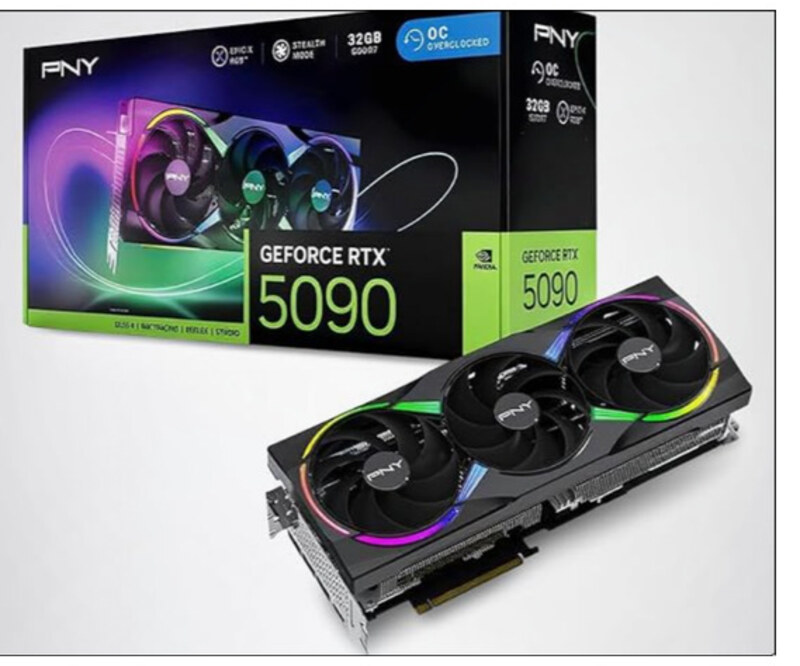
- GPU: NVIDIA GeForce RTX 5090, Blackwell architecture
- Memory: 32GB GDDR7
- Cooling: Triple-fan, 3.5-slot design with Epic-X RGB lighting
- Connectivity: PCIe 5.0, HDMI 2.1, DisplayPort 2.1
- Features: DLSS 4, full Blackwell feature set
- Condition: Used, fully tested and working. No original box. Sold as-is.
Card two: MSI RTX 5090 32GB Ventus 3X OC
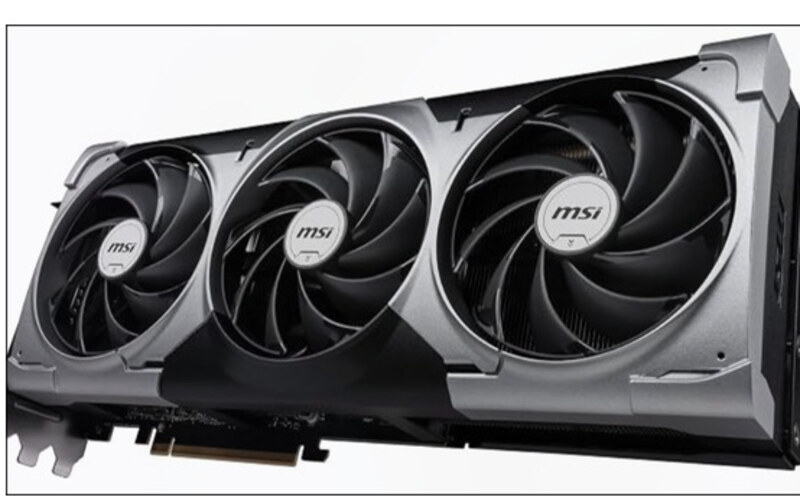
- GPU: NVIDIA GeForce RTX 5090, Blackwell architecture
- Memory: 32GB GDDR7, 512-bit memory bus
- Clocks: Boost frequency up to 2452 MHz
- Cooling: MSI Ventus 3X triple-fan, ATX form factor
- Connectivity: PCIe 5.0, three DisplayPort 2.1, one HDMI 2.1
- Features: DLSS 4, full Blackwell feature set
- Condition: Used, fully tested and working. No original box. Sold as-is.
Condition, shipping, and terms
We believe in being straight with buyers, so here is exactly what you are getting:
- Condition: Both cards are used and fully tested. They power on, they pass stress testing, and they perform to spec. They are sold as-is.
- No original box. We do not have the retail packaging for both cards. They will be packed carefully and securely for transit in protective, anti-static packaging.
- No returns. Because these are tested, as-is used cards sold at a fair price, all sales are final. If you have questions about condition or fit before buying, call us first and we will answer honestly.
- Shipping: Free standard shipping within the United States. Given the size and value of these cards we cannot offer free shipping to Canada, but we are happy to ship there at cost. Canadian buyers, call Penny at 919-348-4912 for a shipping quote before ordering. We collect your shipping address and phone number at checkout and email tracking within one to two business days.
- Payment: Secure checkout through Stripe. We never see or store your card details.
If you want to inspect, ask about benchmark results, or negotiate on the pair, the fastest path is a phone call to Penny at 919-348-4912. We are a real company with a real reputation, and we would rather you buy with confidence than buy with doubt.
Build it, host it, or have us do it
Buying the card is step one. If you want help turning it into a working local AI system, that is what we do every day. Petronella Technology Group designs and builds custom AI workstations tuned for local inference, we offer GPU server hosting for teams that want the horsepower without the hardware in their own closet, and our broader AI services cover everything from model selection to private retrieval systems for regulated data. If you are weighing local versus cloud for sensitive workloads, our AI overview is a good place to start.
We also keep useful hardware moving through the community when we can. If you build GB10 and DGX Spark clusters, see our writeup on the QSFP112 400G cluster cables we stock.
Local versus cloud: the math that is changing minds
The argument for local AI used to be mostly about principle. Today it is increasingly about arithmetic. Consider a small team running a private assistant over its own documents, handling a few thousand model calls a day across drafting, search, and analysis. On metered cloud pricing, that workload generates a recurring monthly bill that never stops and grows with usage. The same workload on a single owned RTX 5090 has a one-time hardware cost and then a modest electricity cost, and the card keeps working long after it has paid for itself.
The break-even point arrives faster than most people expect. Once a team is past the experimentation phase and into daily production use, the cumulative cloud spend over a year frequently exceeds the cost of the hardware that would have run the same work in-house. After that point, every additional query on owned hardware is effectively free, while every additional query in the cloud is another line on the invoice. That is the calculation that keeps moving budgets toward local inference, and it is why a 32GB card that can serve real models is such a practical purchase right now.
Cloud still wins for spiky, unpredictable, or massive-scale workloads, and there is no shame in a hybrid approach. But for steady, sensitive, day-in day-out inference, owning the silicon is usually the cheaper and safer answer, and it gets cheaper every month you keep using it.
Getting started the day your card arrives
One of the quiet wins of local AI in 2026 is that the software has caught up with the hardware. You do not need a research background to get a model running. The typical path looks like this:
- Drop the card in a supported system. The RTX 5090 needs a modern PCIe 5.0 slot, adequate case clearance for a triple-fan cooler, and a power supply with enough headroom and the correct connectors. If you are unsure about fit, send us your build and we will sanity-check it.
- Install the driver and a runtime. Current NVIDIA drivers plus a local inference runtime get you to a working chat interface quickly, with no cloud account required.
- Pull a model and run it. Strong open-weight models are a single download away, and 32GB of memory means you are not stuck with the smallest options.
- Point it at your own data. Adding a retrieval layer lets the model answer from your files, your wiki, and your records, all without anything leaving your network.
If you would rather skip the setup entirely, we build turnkey local AI workstations and we host GPU servers for teams that want the capability without managing the box. Either way, the card you buy here is the foundation, and it is a foundation that holds its value because the demand behind it is not slowing down.
FAQ
Are these cards new or used?
Both are used. Each one ran inside a working machine at Petronella Technology Group, has been fully tested, and performs to specification. They are sold as-is with no original box and no returns.
Why are they priced at $4,599 if the suggested price was $1,999?
Almost nobody has been able to buy an RTX 5090 at the suggested price. As of this writing, new RTX 5090 cards on Amazon list around $4,599 for the PNY and roughly $5,600 for the MSI Ventus 3X, when they are in stock. Our prices, $4,599 for the PNY and $4,999 for the MSI, put each card at or below what a new one of that model costs, except ours are tested and ship today with no backorder. We also accept reasonable offers, especially if you take both cards.
Can I buy both?
Yes, and we encourage it. Two cards roughly double your local AI memory and throughput. Buy both through the links above, or call Penny at 919-348-4912 to discuss a pair price.
What can I run on 32GB of GPU memory?
Plenty. Strong open-weight language models in the 20-billion to 70-billion parameter range with quantization, retrieval over your own documents, high-resolution image generation, real-time speech models, and light fine-tuning all run comfortably on a single 32GB RTX 5090.
Do you offer a warranty?
These are used cards sold as-is, so they do not carry a warranty from us. We test every card before it ships and we describe condition honestly. If you have concerns, call before you buy.
Where do you ship?
Free standard shipping within the United States. We can ship to Canada, but not for free given the size and value of these cards, so call Penny at 919-348-4912 for a Canada shipping quote before ordering. Address and phone are collected at checkout, and tracking is emailed within one to two business days.
Ready to bring AI in-house
Local AI is no longer an experiment for hobbyists. It is how serious organizations keep their data private, control their costs, and stay compliant while still getting the benefit of modern models. The hardware to do it is expensive and hard to find at a fair price. We have two known-good RTX 5090 32GB cards ready to ship today.
Want a system like this? Petronella Technology Group, Inc. designs and builds local AI workstations and servers for businesses that need their data to stay in-house. Call Penny at 919-348-4912 or book a free AI strategy consultation.
Related reading: planning a build around these cards? The Private AI Infrastructure Blueprint walks through the full production stack, from GPU selection to serving, monitoring, and hardening.
Reference build sheets, a hardening checklist for open-weight model hosting and a data-sovereignty map for running AI on your own hardware.
Get the free guide